
Pre-Cured CFRP: Plates and Laminates for External Bonding
Pre-cured carbon fiber reinforced polymer (CFRP) systems — plates and laminates — offer a fundamentally different approach to structural strengthening compared to wet lay-up fabric systems. The carbon fiber is factory-impregnated and cured under controlled conditions, producing a rigid strip with consistent fiber volume fraction (65% or higher), precise dimensions, and predictable mechanical properties.
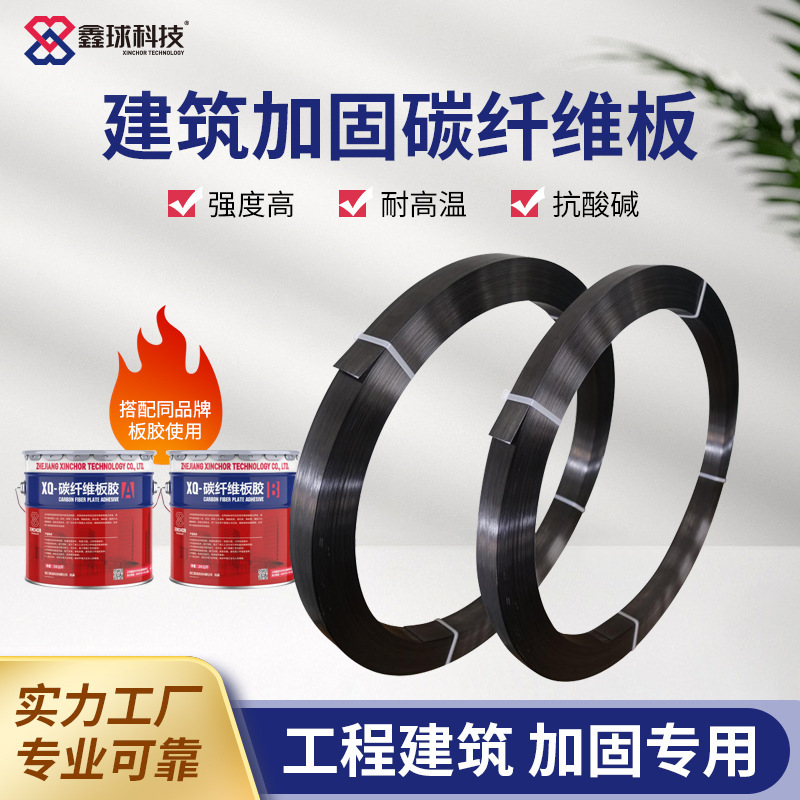
The installation process is straightforward: clean the concrete surface, apply structural adhesive, and bond the plate or laminate in place. No on-site resin mixing, no fabric saturation, no vacuum bagging. This simplicity makes pre-cured CFRP systems the preferred choice for beam soffit strengthening, where the flat geometry is ideally suited to rigid strips.
1.2mm Plate vs 1.4mm Laminate: Key Differences
| Property | 1.2mm CFRP Plate | 1.4mm Carbon Fiber Laminate |
|---|---|---|
| Tensile Strength | ≥ 2,400 MPa | ≥ 2,400 MPa |
| Elastic Modulus | ≥ 160 GPa | ≥ 165 GPa |
| Fiber Volume Fraction | ≥ 65% | ≥ 65% |
| Density | 1.6 g/cm³ | 1.6 g/cm³ |
| Available Widths | 50 / 80 / 100 mm | 50 / 80 / 100 mm |
| Maximum Length | Up to 50 m | Up to 50 m |
| Cross-Sectional Area (50mm) | 60 mm² | 70 mm² |
| Tensile Capacity (50mm) | ≥ 144 kN | ≥ 168 kN |
| Weight per Meter (50mm) | 96 g/m | 112 g/m |
| Surface Treatment | Peel-ply textured | Peel-ply textured |
The primary difference is clear: the 1.4mm laminate provides 17% more cross-sectional area — and therefore 17% more tensile capacity — than the 1.2mm plate at the same width. This additional capacity comes from the extra 0.2mm of thickness, which also increases the second moment of area (stiffness) of the CFRP strip itself.
When to Choose 1.2mm CFRP Plate
The 1.2mm plate is our most widely used pultruded product. It covers the majority of beam strengthening applications where the required CFRP area falls within standard design ranges.
Ideal applications for 1.2mm:- Building beam flexural strengthening where the design requires moderate CFRP area
- Slab soffit reinforcement — the thinner profile minimizes headroom reduction
- Applications where aesthetics matter and minimal protrusion is preferred
- Projects with tight adhesive thickness tolerance (the thinner plate is easier to level)
- Cost-sensitive projects where the lower material cost per meter matters
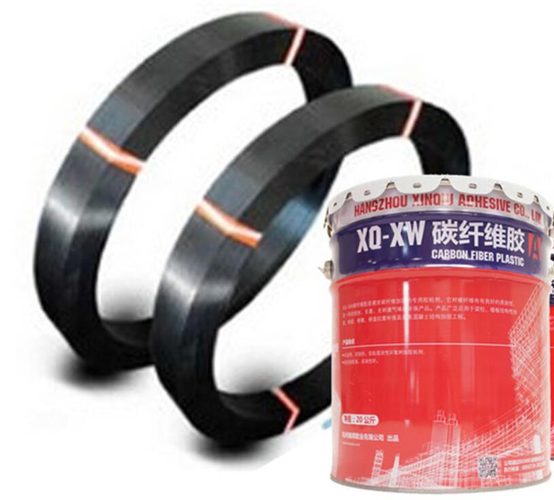
When to Choose 1.4mm Carbon Fiber Laminate
The 1.4mm laminate is the heavy-duty option for applications requiring maximum tensile capacity without increasing the strip width.
Ideal applications for 1.4mm:- Bridge girder strengthening where high tensile loads are specified
- Building beam reinforcement where the design calculation shows 1.2mm is insufficient but space constraints prevent using a wider plate
- Seismic upgrade projects requiring additional flexural capacity in critical zones
- Parking structure upgrade to accommodate heavier vehicle loads
- Industrial structures carrying dynamic loads (cranes, heavy machinery)
Installation Comparison
Both the 1.2mm plate and 1.4mm laminate use the same installation procedure:
Step 1: Surface preparation. Remove laitance from the concrete soffit by grinding to expose aggregate (CSP 3 to 5). The concrete pull-off strength must be at least 1.5 MPa — if it is lower, the substrate is too weak for external bonding and must be repaired first. Step 2: Plate preparation. Clean the bonding surface of the CFRP strip with acetone or MEK solvent. Our plates and laminates come with a peel-ply texture — peel off the protective layer immediately before bonding to expose a fresh, roughened surface. Step 3: Adhesive application. Apply CFRP plate bonding adhesive (our XQ-PB adhesive, shear strength ≥ 18 MPa) to both the concrete surface and the CFRP strip. The typical adhesive thickness is 1 to 3 mm. Use a notched trowel to create a slightly convex (dome-shaped) adhesive layer on the CFRP strip — this ensures full contact when pressed against the soffit and eliminates air pockets. Step 4: Bonding. Press the CFRP strip against the concrete surface and apply uniform pressure using temporary supports (props, spring clamps, or vacuum bags). Adhesive should squeeze out slightly along both edges — this confirms full contact. Step 5: Curing. Maintain support for a minimum of 24 hours at 25°C. Full adhesive cure takes 7 days. Do not load the strengthened member until the adhesive has reached full cure strength. Installation tip: The 1.4mm laminate is slightly stiffer than the 1.2mm plate, which means it requires slightly more pressure to conform to minor surface irregularities. Pre-heat the laminate to 40 to 50°C with a heat gun if the concrete surface has a slight camber — this temporarily increases flexibility and improves contact.Cost-Effectiveness Analysis
| Factor | 1.2mm Plate | 1.4mm Laminate |
|---|---|---|
| Material Cost per Meter (50mm) | Lower | ~15% higher |
| Tensile Capacity per Meter | 144 kN (50mm width) | 168 kN (50mm width) |
| Cost per kN of Capacity | Baseline | ~2% lower |
| Installation Labor | Same | Same |
| Adhesive Consumption | Same | Same |
On a pure cost-per-kN basis, the 1.4mm laminate is actually marginally more economical than the 1.2mm plate. This is because the installation labor (which is typically 40 to 60 percent of the total installed cost) is identical for both thicknesses — you are bonding one strip either way. The extra capacity comes "almost free" since the material cost increase (approximately 15%) is spread across 17% more tensile capacity.
Combining with Carbon Fiber Fabric
In many projects, CFRP plates or laminates are used together with carbon fiber fabric to address different strengthening needs on the same structure:
- Plates or laminates on the beam soffit for flexural strengthening (tensile capacity)
- Fabric U-wraps on the beam sides for shear strengthening (confinement)
Specification Checklist
When specifying CFRP plates or laminates for your project, provide these details:
We maintain stock of standard dimensions (1.2mm × 50mm and 1.4mm × 100mm) for quick shipment. Custom widths and cut lengths are available with 2 to 3 weeks lead time.
Explore our CFRP plate and laminate products or request a technical consultation to determine the optimal thickness and width for your project.