
The Critical Decision: Chemical vs. Mechanical Anchoring
When a structural engineer specifies post-installed rebar connections — whether for building extensions, seismic retrofits, or infrastructure rehabilitation — the choice between chemical anchor adhesives and mechanical expansion anchors fundamentally affects the connection's performance, durability, and cost.
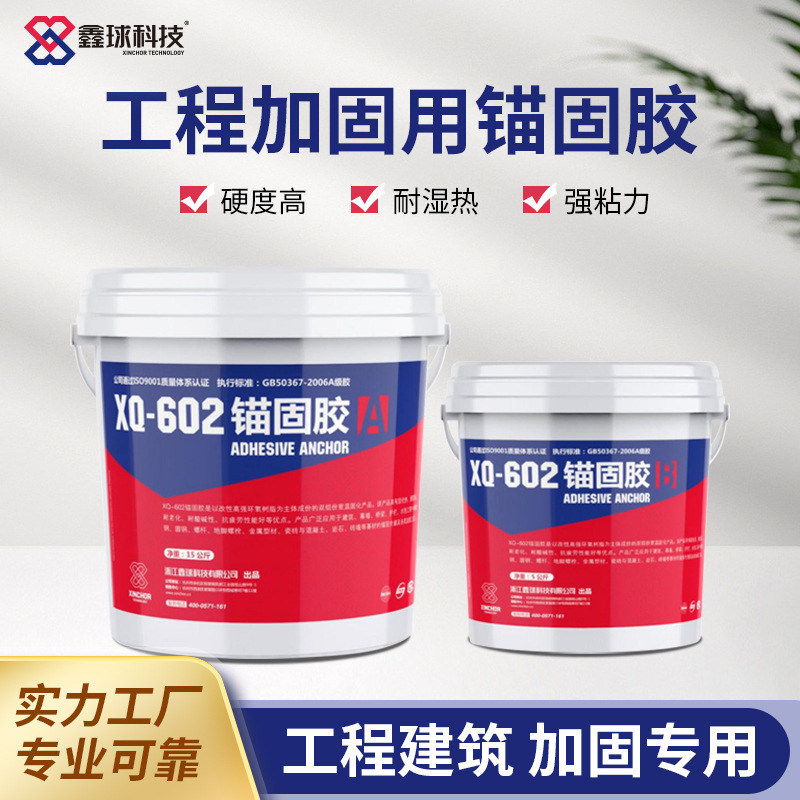
As a manufacturer producing both epoxy and vinyl ester anchor adhesives, we have seen firsthand how the wrong choice can lead to premature failures. Having supplied anchor systems for projects in over 30 countries, here is our honest assessment of when to use each system — and why chemical anchoring is increasingly the preferred choice for structural rebar connections.
How Each System Works
Chemical Anchor Adhesives
Chemical anchoring uses a two-component reactive adhesive — typically epoxy or vinyl ester resin — injected into a drilled hole. The rebar is inserted into the filled hole, and the adhesive cures to form a rigid bond between the rebar, adhesive, and concrete substrate.
The load transfer mechanism is fundamentally different from mechanical anchors: chemical anchors distribute stress along the entire embedment length through adhesive bond. This creates a uniform stress distribution with no localized stress concentrations.
Our Epoxy Anchor Adhesive XQ-ZJ-360 achieves bond strength of 10 MPa or above in C25 concrete, meaning a 20mm diameter rebar with 200mm embedment depth can resist a pull-out force of approximately 125 kN — well above the rebar's yield force.
Mechanical Expansion Anchors
Mechanical anchors work through friction and wedge action. An expansion sleeve or wedge is forced against the borehole wall when the bolt is tightened, creating a friction-based connection.
The load is transferred through localized bearing pressure at the expansion zone, which creates high stress concentrations in the concrete surrounding the anchor. This is why mechanical anchors require larger edge distances and spacing compared to chemical anchors.
Head-to-Head Comparison
Bond Strength and Load Capacity
| Parameter | Chemical Anchor (Epoxy XQ-ZJ-360) | Mechanical Expansion Anchor |
|---|---|---|
| Bond Stress | ≥ 10 MPa uniform | N/A (friction-based) |
| Pull-out (M20, 200mm embed) | ~125 kN | ~60-80 kN |
| Shear Capacity | Comparable (determined by steel) | Comparable (determined by steel) |
| Edge Distance (minimum) | 50mm | 100mm+ |
| Spacing (minimum) | 100mm | 200mm+ |
The advantage of chemical anchors is pronounced in close spacing and near-edge applications — exactly the situations that arise most frequently in structural rehabilitation work, where new rebar must be planted close to existing reinforcement.
Seismic Performance
This is where the difference becomes critical. In seismic zones, post-installed connections must withstand cyclic loading without progressive degradation.
Chemical anchors maintain their bond strength under cyclic loading because the adhesive distributes stress uniformly. Our XQ-ZJ-360 epoxy system is qualified for seismic categories C1 and C2, and has been tested to 100+ load cycles at 75% of ultimate capacity without measurable bond degradation. Mechanical anchors are vulnerable to cyclic loading because the friction-based connection can progressively lose clamping force. Each load cycle causes micro-crushing of the concrete at the expansion zone, gradually reducing the effective bearing area. Most standard mechanical anchors are only approved for seismic category C1, and many codes restrict their use for structural connections in high seismicity zones.For seismic retrofit projects — which represent a growing share of infrastructure work in earthquake-prone regions like Southeast Asia and South America — chemical anchoring is often the only approved method for post-installed rebar connections.
Concrete Condition Tolerance
Real-world concrete is rarely in perfect condition. Cracks, low strength, and moisture are common:
- Cracked concrete: Chemical anchors maintain approximately 75% of their uncracked capacity in cracked concrete (crack width up to 0.3mm). Mechanical anchors can lose 40 to 50% of capacity.
- Low-strength concrete: Chemical anchor capacity is proportional to concrete strength, but the bond-line failure mode is more predictable. Mechanical anchors in weak concrete risk cone pull-out failure.
- Wet boreholes: Standard epoxy systems require dry holes. Our vinyl ester formula (XQ-ZJ-V390) can be installed in damp conditions. Mechanical anchors generally tolerate wet holes.
Installation Comparison
Chemical anchor installation:The key difference is tolerance for hole quality. Chemical anchors fill any gap between the rebar and hole wall, accommodating minor variations in hole diameter and straightness. Mechanical anchors require precise hole diameters — an oversized hole means reduced expansion force and compromised capacity.
Cost Analysis
Based on our project data for a typical structural connection (M20 rebar, 200mm embedment, C30 concrete):
| Cost Component | Chemical Anchor | Mechanical Anchor |
|---|---|---|
| Material cost per point | $3.50-5.00 | $4.00-8.00 |
| Installation time per point | 5-8 minutes | 3-5 minutes |
| Hole drilling time | Similar | Similar |
| Quality verification | Pull-out test sampling | Torque verification |
| Failure cost (if defective) | Low — adhesive fills voids | High — must redrill |
The material cost difference is often negligible, but chemical anchors offer lower total installed cost on large projects because:
- Less sensitive to hole tolerances (fewer rejected installations)
- No torque wrenches or specialized installation tools required
- Bulk packaging (20 kg buckets) available for high-volume projects — our XQ-ZJ-B20 reduces per-point material cost by 30 to 40% compared to cartridge systems
When to Choose Chemical Anchor Adhesive
Based on two decades of manufacturing and project experience, we recommend chemical anchor adhesives when:
When Mechanical Anchors May Be Adequate
Mechanical anchors remain a valid choice for:
- Non-structural fixings (facades, MEP supports, equipment brackets)
- Temporary connections (formwork, scaffolding anchors)
- Applications requiring immediate load capacity (no cure time)
- Situations where the connection must be removable
Frequently Asked Questions
How deep should the hole be for rebar planting with anchor adhesive?
The standard embedment depth is 10 to 15 times the rebar diameter. For structural connections designed to develop the full yield strength of the rebar, we recommend a minimum of 15d (15 times the rebar diameter). For example, a 20mm rebar requires a minimum hole depth of 300mm. Our engineering team can provide specific embedment calculations based on your concrete grade and design loads.
Can anchor adhesive be used in overhead (upward-facing) holes?
Yes. Both our epoxy (XQ-ZJ-360) and vinyl ester (XQ-ZJ-V390) formulas are thixotropic — they remain in the hole without dripping when injected into overhead or horizontal holes. The injection must proceed from the bottom of the hole toward the opening to avoid trapping air. Our cartridge systems with static mixers are specifically designed for overhead application.
What is the cure time for epoxy anchor adhesive?
Our epoxy anchor adhesive XQ-ZJ-360 reaches full load capacity in 24 hours at 25 degrees Celsius. At lower temperatures, cure time extends — approximately 48 hours at 10 degrees Celsius and 72 hours at 5 degrees Celsius. For time-critical projects, our vinyl ester formula XQ-ZJ-V390 reaches full load capacity in just 45 minutes at 25 degrees Celsius.
How do you verify the quality of installed chemical anchors?
Quality verification typically involves three methods: (1) visual inspection of adhesive overflow at the hole entrance (confirming full fill), (2) pull-out testing of sample anchors to 80% of design load (typically 3 to 5% of installed anchors are tested), and (3) checking adhesive batch test certificates against specification requirements. We provide detailed QA/QC protocols with every project.
Are chemical anchors approved by international building codes?
Yes. Chemical anchor adhesives are recognized by all major international codes including ACI 318 Appendix D (USA), EN 1992-4 (Europe), and GB 50367 (China). Our products carry test reports per ETAG 001 (now EAD 330499) and comply with ICC-ES AC308 evaluation criteria. We provide code compliance documentation for specific regional requirements upon request.
Make the Right Connection Choice
The integrity of your structure depends on reliable connections. Whether you need high-performance epoxy for seismic-critical rebar planting or fast-cure vinyl ester for rapid construction, we manufacture the full range of anchor adhesive systems.
Browse our complete anchor adhesive product line or request a technical consultation with our engineering team.