
What Is an Epoxy Anchor?
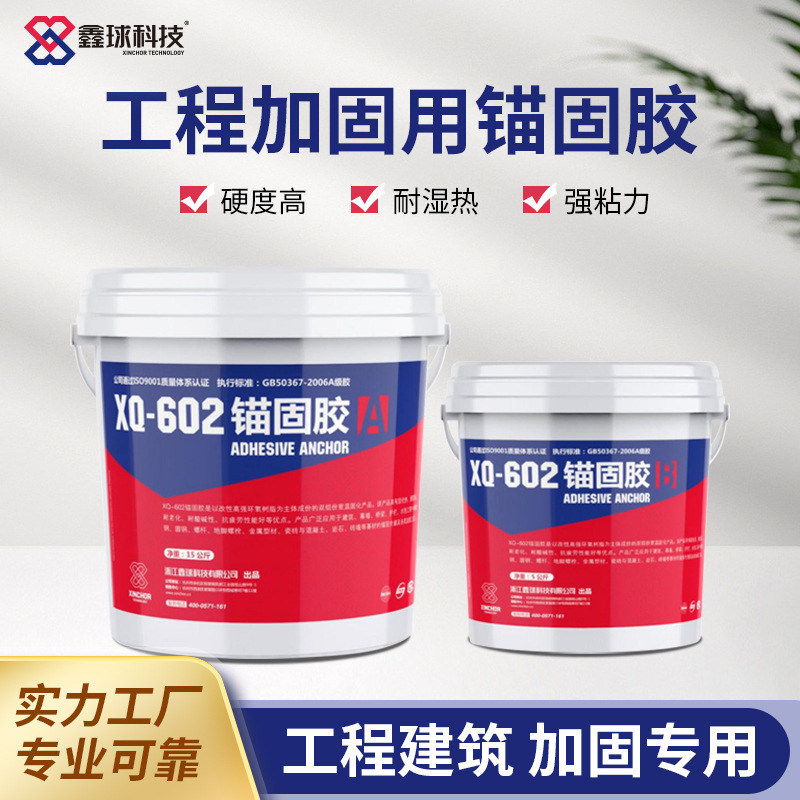
An epoxy anchor is a two-component adhesive fastening system that bonds threaded rods, rebar, or bolts into drilled holes in concrete, masonry, or stone. The two components — an epoxy resin (Part A) and a hardener (Part B) — are dispensed through a static mixing nozzle directly into the drilled hole, where they chemically react and cure into a rigid thermoset polymer that locks the steel element in place.
Unlike mechanical expansion anchors that grip through friction and wedging action, epoxy anchors create a chemical bond between the steel, the cured adhesive, and the surrounding concrete. This bonding mechanism delivers three advantages that mechanical anchors cannot match:
- Higher load capacity — especially in tension, because the load is distributed along the entire embedment length rather than concentrated at the expansion zone
- Reduced edge distance — no expansion forces mean less risk of concrete splitting near edges
- Performance in cracked concrete — qualified epoxy and vinyl ester formulations maintain capacity even when the concrete is cracked (seismic zones, aging structures)
Types of Epoxy Anchors: 7 Systems Compared
The term "epoxy anchor" is used loosely in the industry to describe any chemical anchor. In reality, there are distinct resin chemistries, each suited to different conditions. Here is how the seven main systems compare:
| System | Resin Chemistry | Bond Strength (C30) | Cure Time (25°C) | Wet Hole? | Cracked Concrete? | Service Temp | Best Application |
|---|---|---|---|---|---|---|---|
| Pure Epoxy | Bisphenol-A/F + amine | 12–13 MPa | 24 hours | No | No | -40 to 60°C | Standard structural anchoring |
| Fast-Set Epoxy | Modified epoxy + accelerator | 10–12 MPa | 6–8 hours | No | No | -30 to 60°C | Quick-turnaround projects |
| Vinyl Ester | Vinyl ester + peroxide | 10–12 MPa | 6–8 hours | Yes | Yes (C1/C2) | -40 to 80°C | Seismic, wet, hot climates |
| Epoxy-Vinyl Hybrid | Blended resin | 11–13 MPa | 12 hours | Damp only | Yes (C1) | -40 to 70°C | General purpose |
| Polyester | Unsaturated polyester | 8–10 MPa | 1–4 hours | No | No | -20 to 50°C | Light-duty, cost-sensitive |
| Injectable Epoxy | Low-viscosity epoxy | 10–11 MPa | 24 hours | No | No | -40 to 60°C | Overhead, small diameters |
| Bulk Epoxy (20kg) | Bisphenol-A epoxy | 12–13 MPa | 24 hours | No | No | -40 to 60°C | High-volume projects |
Our product range covers all seven categories: view the complete anchor adhesive lineup.
Epoxy Anchors vs Mechanical Anchors vs Chemical Anchors: Head-to-Head
Engineers frequently ask us: when should I use an epoxy anchor instead of a mechanical anchor? And what exactly is the difference between an "epoxy anchor" and a "chemical anchor"?
Terminology clarification: All epoxy anchors are chemical anchors, but not all chemical anchors are epoxy anchors. "Chemical anchor" is the umbrella term that includes epoxy, vinyl ester, polyester, and hybrid resin systems. "Epoxy anchor" refers specifically to anchor systems using epoxy-based resin chemistry.| Factor | Epoxy Anchor | Mechanical Expansion Anchor | Undercut Anchor |
|---|---|---|---|
| Tensile capacity (M16, C30) | 80 kN (at 10d embedment) | 35–50 kN | 55–70 kN |
| Min. edge distance | 1.5 × embedment depth | 3–5 × anchor diameter | 2.5 × embedment depth |
| Min. spacing | 3 × embedment depth | 6 × anchor diameter | 4 × embedment depth |
| Cracked concrete performance | Vinyl ester: yes; Pure epoxy: no | Torque-controlled: no; Displacement-controlled: yes | Yes |
| Loading time | After cure (6–24 hours) | Immediate | Immediate |
| Removability | Permanent | Some types removable | Removable |
| Overhead installation | Yes (with proper nozzle) | Yes | Yes |
| Hole tolerance | 2–6mm annular gap | Exact match required | Exact match required |
| Cost per anchor | Higher (adhesive + rod) | Lower | Higher |
| Vibration resistance | Excellent (no slip) | Moderate (can loosen) | Good |
For a deeper dive into this comparison, see our adhesive anchor vs mechanical anchor guide.
Pull-Out Load Capacity: M8 to M36 in C20 to C50
The following table provides characteristic tensile pull-out capacities for epoxy anchors installed using our standard epoxy adhesive (XQ-ZJ-E585) at standard embedment depth (10 times the rod diameter) in uncracked concrete. All values are based on testing per ASTM E488 and EOTA TR048.
| Rod Size | Hole Dia. | Embedment (10d) | C20 | C25 | C30 | C35 | C40 | C50 |
|---|---|---|---|---|---|---|---|---|
| M8 | 12 mm | 80 mm | 18 kN | 22 kN | 26 kN | 29 kN | 32 kN | 37 kN |
| M10 | 14 mm | 100 mm | 28 kN | 34 kN | 40 kN | 44 kN | 48 kN | 56 kN |
| M12 | 16 mm | 120 mm | 42 kN | 48 kN | 52 kN | 58 kN | 60 kN | 72 kN |
| M16 | 20 mm | 160 mm | 65 kN | 72 kN | 80 kN | 88 kN | 95 kN | 112 kN |
| M20 | 25 mm | 200 mm | 90 kN | 100 kN | 110 kN | 122 kN | 130 kN | 155 kN |
| M24 | 30 mm | 240 mm | 120 kN | 134 kN | 148 kN | 162 kN | 175 kN | 208 kN |
| M30 | 36 mm | 300 mm | 160 kN | 180 kN | 198 kN | 218 kN | 235 kN | 280 kN |
| M36 | 42 mm | 360 mm | 205 kN | 230 kN | 255 kN | 280 kN | 305 kN | 360 kN |
*Values are 5th-percentile characteristic tensile capacities for single anchors with edge distance of at least 1.5 times the embedment depth. Design capacity = characteristic capacity divided by the applicable safety factor (typically 2.0 to 2.5 per EN 1992-4 or ACI 318 Appendix D).*
Engineering insight: Starting from M16 in C30 concrete, the epoxy anchor pull-out capacity (80 kN) exceeds the yield force of Grade 400 reinforcement bar (approximately 80 kN for M16). This means the steel yields before the adhesive bond fails — the anchor is stronger than the rod it holds. This is the definition of a ductile connection, which is precisely what seismic design codes require.For shear capacity, the governing failure mode is typically steel shear strength or concrete edge breakout — not the adhesive bond. Contact our engineering team with your specific loading scenario for design verification.
Installation: 8 Steps to Full-Capacity Epoxy Anchors
Proper installation is not optional — it is the difference between an anchor that achieves 100% of its design capacity and one that fails at 50%. Based on our laboratory testing of 60 anchors under six different hole preparation conditions, improper hole cleaning alone can reduce capacity by 50%.
Step 1: Drill the Hole
Use a rotary hammer drill with a carbide-tipped bit. Drill to the specified diameter (typically rod diameter + 4 to 6 mm annular gap) and depth (embedment depth + 10 mm for debris clearance).
Critical: Do not use diamond core drills unless you roughen the hole wall afterward. Diamond drills create a smooth, glazed surface that reduces adhesive bond by 20 to 30%.Step 2: Blow — First Air Purge
Insert the nozzle of a manual blow pump or compressed air line to the bottom of the hole. Blow outward for a minimum of 4 seconds. This removes the bulk drilling debris.
Step 3: Brush — Wire Brush Scrubbing
Insert a wire brush (matching the hole diameter) and scrub the hole wall with at least 4 strokes in and out. The brush dislodges fine drilling dust that compressed air alone cannot remove from the roughened concrete surface.
Step 4: Blow — Second Air Purge
Repeat the air purge after brushing. This removes the dust loosened by the wire brush.
Step 5: Repeat Brush and Blow (Blow-Brush-Blow-Brush-Blow)
For critical applications (seismic, overhead, safety-critical connections), perform a second brush-and-blow cycle. Our laboratory data shows this five-step cleaning protocol achieves the baseline 100% capacity, while a single blow-only cleaning retains only 84%.
Step 6: Inject Adhesive
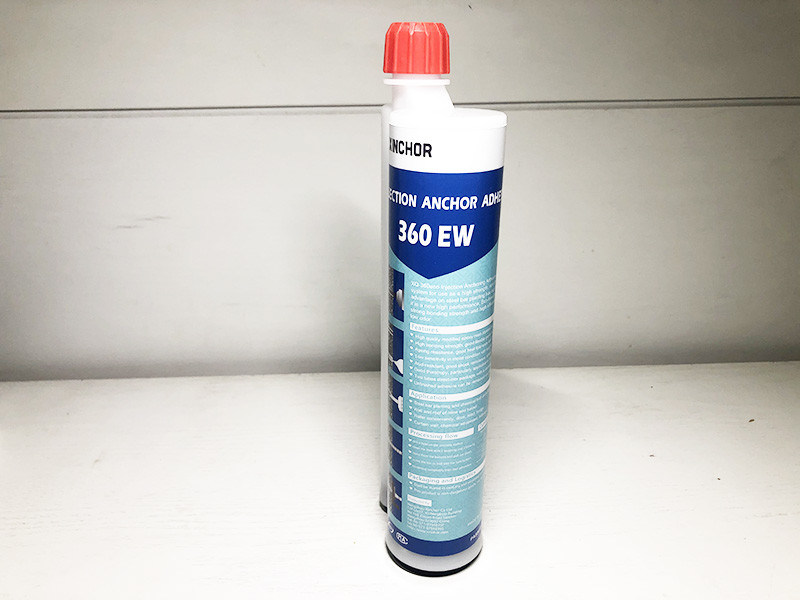
Insert the static mixing nozzle to the bottom of the hole. Dispense adhesive from bottom to top, filling approximately two-thirds of the hole volume. Injecting from the bottom up prevents air entrapment — injecting from the top traps air bubbles at the base, which creates a void directly at the point of maximum bond stress.
Step 7: Insert Rod
Push the threaded rod or rebar into the hole with a slow rotating motion. Adhesive should squeeze out at the surface — this confirms the hole is fully filled. If no adhesive appears, the hole is either too large or was not filled sufficiently.
Step 8: Support and Cure
Do not disturb the anchor during the cure period. At 25 degrees Celsius, our standard epoxy (XQ-ZJ-E585) reaches load-bearing capacity at 12 hours and full design strength at 24 hours. At 5 degrees Celsius, full cure extends to 7 days. See our detailed cure time table for temperature-specific data.
Application Scenarios: Where Epoxy Anchors Are Specified
1. Curtain Wall and Facade Connections
Curtain wall brackets, stone cladding anchors, and facade panel fixings operate near concrete edges where mechanical anchors would cause splitting. Epoxy anchors provide the reduced edge distance and vibration resistance required for facade applications. Our 360ml cartridge (XQ-ZJ-360) is the standard choice for mid-rise curtain wall projects — one cartridge installs approximately 15 to 20 M12 anchors.
2. Bridge and Highway Infrastructure
Bridge bearing plate anchorage, barrier rail connections, sign structure foundations, and bridge deck overlay anchoring all benefit from epoxy anchor systems. The higher per-anchor cost is offset by faster installation and elimination of expansion-induced concrete damage on aging bridge decks. For CFRP plate bonding combined with anchor systems, see our bridge strengthening guide.
3. Seismic Retrofit of Existing Structures
Post-installed anchors for seismic retrofit must be qualified per EOTA EAD 330499 or ACI 355.4 for use in cracked concrete under seismic loading. Our vinyl ester formulation (XQ-ZJ-VF650) is qualified for seismic performance categories C1 and C2, meaning it maintains design capacity under cyclic loading at crack widths up to 0.5 mm.
4. Industrial Equipment and Machinery Mounting
Heavy machinery, pump bases, compressor skids, and generator foundations require anchors that resist both static and dynamic (vibratory) loads. Epoxy anchors are preferred over mechanical anchors for machinery mounting because the full-length bond prevents the micro-slip and progressive loosening that plagues wedge anchors under vibration.
5. Rebar Planting and Structural Connections
When existing concrete structures need additional reinforcement — adding floors, extending beams, connecting new walls to existing columns — epoxy anchors bond planted rebar into the existing concrete with capacities that match cast-in-place rebar. See our rebar epoxy anchoring guide for embedment depth calculations and design tables.
Temperature and Cure: What Every Contractor Must Know
Cure speed is the most underestimated variable in epoxy anchor performance. A contractor who installs anchors at 5 degrees Celsius and loads them at 24 hours — following the same schedule as a summer project — will load an anchor at only 40% of its design capacity.
| Temperature | Working Time | 50% Strength | Full Cure (95%+) |
|---|---|---|---|
| 5°C | 25 min | 72 hours | 7 days |
| 15°C | 10 min | 24 hours | 3 days |
| 25°C | 6 min | 12 hours | 24 hours |
| 35°C | 3 min | 6 hours | 12 hours |
Common Failure Modes and How to Prevent Them
In two decades of manufacturing anchor adhesives and analyzing returned samples, we have identified five failure modes that account for over 95% of field failures:
Wholesale Epoxy Anchors — Factory Direct Pricing
XINCHOR manufactures the complete range of epoxy anchor adhesives at our ISO 9001 certified facility in Changxing, Zhejiang, China. We hold 26 national patents covering anchor adhesive formulations, dispensing mechanisms, and testing methods.
Available cartridge sizes: 360ml, 390ml, 420ml, 585ml, 600ml, 650ml — all resin chemistries (pure epoxy, vinyl ester, hybrid, injectable). Plus 20kg bulk packaging for high-volume projects. MOQ: 500 cartridges per formulation. Private labeling and custom packaging available. Typical lead time: 15 to 25 working days from order confirmation. Request a quote for wholesale epoxy anchors | View our anchor adhesive product rangeFrequently Asked Questions
How long do epoxy anchors last in concrete?
Epoxy anchors have a design service life of 50 years or more when properly installed. The cured epoxy resin does not degrade under normal environmental conditions — it is resistant to moisture, alkalinity (concrete is pH 12 to 13), and most construction chemicals. The critical factor is the glass transition temperature (Tg): our standard epoxy has a Tg of 62 degrees Celsius, which is well above any service temperature in building applications. For sustained elevated temperatures above 50 degrees Celsius (such as industrial chimneys or hot-process equipment), specify our vinyl ester formulation with a Tg of 105 degrees Celsius.
Can epoxy anchors be used in wet or underwater concrete?
Standard epoxy anchors require dry hole conditions. For damp holes, our hybrid formulation (XQ-ZJ-C420) retains 65 to 75% of dry-hole capacity. For wet or water-filled holes, our vinyl ester formulation (XQ-ZJ-V390) retains 65 to 75% capacity even when the hole is flooded. For underwater installation, contact our engineering team — we have supplied specialized formulations for marine pile cap anchoring in Southeast Asia.
What is the minimum embedment depth for epoxy anchors?
The standard minimum embedment depth is 10 times the rod or rebar diameter (10d). For an M16 threaded rod, this means 160 mm. Deeper embedment increases capacity, but beyond approximately 20d, the failure mode transitions from bond pullout to concrete cone breakout, and additional depth provides diminishing returns. For heavy-duty applications or low-strength concrete (below C20), we recommend 12 to 15d.
Are epoxy anchors code-compliant for structural applications?
Yes. Epoxy anchors can be designed and specified per EN 1992-4 (Eurocode), ACI 318 Appendix D (American standard), or AS 5216 (Australian standard) when the products have been tested and assessed per EOTA EAD 330499, ACI 355.4, or equivalent qualification protocols. Our XQ-ZJ-VF650 vinyl ester is qualified for seismic categories C1 and C2 per EOTA EAD 330499.
How many epoxy anchor cartridges do I need for my project?
A 585ml cartridge installs approximately 8 to 12 M16 anchors at 160 mm embedment (depending on hole diameter tolerance). For M12 anchors at 120 mm embedment, one cartridge covers approximately 15 to 20 anchors. Contact us with your project specifications — anchor size, quantity, embedment depth — and we will calculate the exact cartridge quantity and provide a wholesale quote. Get a project quote