
Project Overview
A newly constructed underground parking garage in Xiaoshan District, Hangzhou required structural reinforcement before service. Underground parking structures face demanding load conditions — repeated dynamic vehicle loads, long-term static loads from soil cover, and strict clearance constraints that rule out conventional strengthening methods like section enlargement.
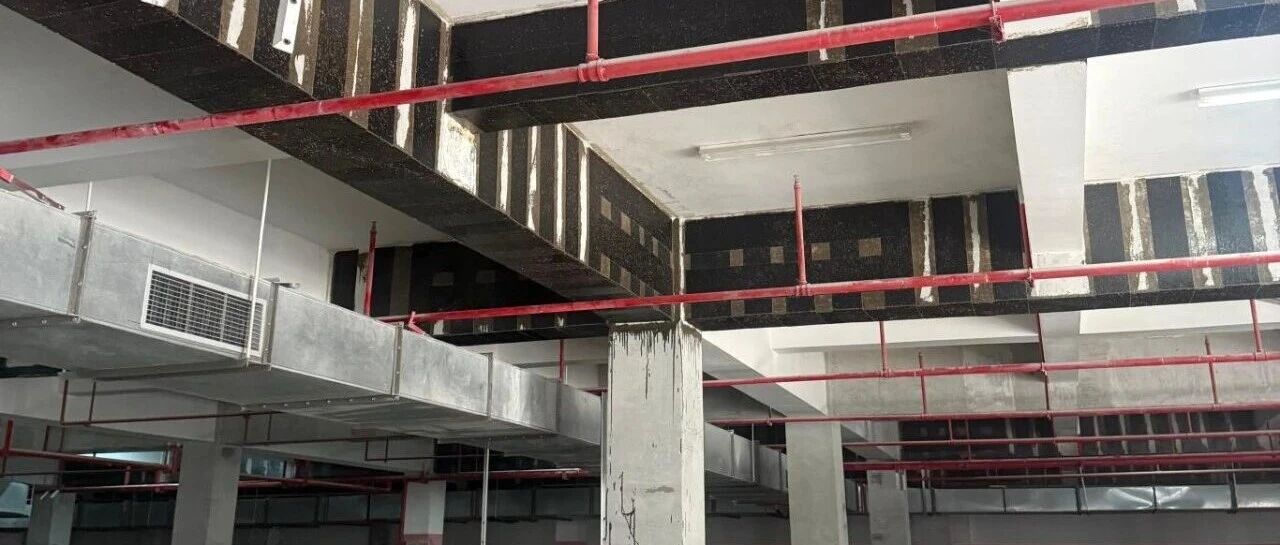
The project targeted primary and secondary beams plus column members, using a combined CFRP fabric + steel plate bonding approach. XINCHOR XQ-XW carbon fiber adhesive, carbon fiber fabric, and structural bonding adhesive were specified for the entire project.
Why This Garage Needed Reinforcement
Three factors drove the decision to strengthen this structure:
Load capacity requirements. Underground garages endure constant vehicle traffic with repeated dynamic loading. The concrete beams experience high bending and shear stresses. To meet current structural codes and provide adequate load capacity reserves, the beams and columns required additional reinforcement beyond the original design. Space constraints. Underground garages are packed with ventilation ducts, fire sprinkler systems, and utility conduits. The limited headroom made section enlargement impossible — any reinforcement method had to add minimal thickness. Both CFRP and steel plate bonding are thin-profile strengthening techniques that preserve the usable clearance. Durability in humid conditions. Underground environments have consistently high humidity, accelerating concrete carbonation. The reinforcement materials had to resist moisture and aging to maintain long-term effectiveness.Reinforcement Method 1: Carbon Fiber Fabric
Carbon fiber fabric, applied with XINCHOR XQ-XW carbon fiber adhesive, was bonded directly to the tensile zones of concrete beams.
Beam soffit application — CFRP fabric bonded to the bottom surface of beams significantly increases flexural capacity, controls downward deflection, and restrains crack propagation. U-wrap shear reinforcement — CFRP fabric applied in a U-shape around the beam sides and bottom enhances shear resistance, preventing diagonal tension failure.Key advantages for garage applications:
The fabric thickness is under 1mm after curing, preserving headroom clearance. The material resists carbonation and moisture degradation in humid underground conditions. A single worker can carry enough fabric to strengthen an entire beam span — total weight including adhesive is under 1 kg/m² versus 47 kg/m² for a 6mm steel plate.
CFRP Installation Process
Reinforcement Method 2: Steel Plate Bonding
For columns with more demanding load requirements, steel plate bonding was used. Steel plates were bonded to the concrete surface using XINCHOR structural adhesive (bonding adhesive for steel), supplemented with mechanical anchor bolts for redundancy.
The steel plates form a composite section with the original concrete, sharing the load and providing additional flexural and shear capacity. U-shaped steel wraps around columns confine the concrete core, increasing both strength and ductility.
Materials Used
| Material | Specification | Role |
|---|---|---|
| XINCHOR Carbon Fiber Fabric | 300g/m², unidirectional 12K | Flexural & shear reinforcement |
| XINCHOR XQ-XW Carbon Fiber Adhesive | Two-component epoxy | CFRP bonding to concrete |
| XINCHOR Structural Adhesive | High-viscosity epoxy | Steel plate bonding |
| Steel Plates | Q345 grade, 4–6mm | Column and beam strengthening |
Project Results
The project has been completed successfully. All reinforcement materials passed on-site testing with results meeting or exceeding the requirements of GB 50367-2013 (Code for Design of Strengthening Concrete Structure). Bond pull-off tests exceeded 2.5 MPa with concrete substrate failure mode — confirming the adhesive bond was stronger than the concrete itself.
FAQ
Q: Can carbon fiber fabric and steel plate bonding be used together? A: Yes. The combined approach is common in complex structures where different members have different requirements. Beams typically receive CFRP for flexural strengthening, while heavily loaded columns get steel plate bonding for maximum capacity increase. Q: How long does CFRP reinforcement last in underground environments? A: With proper installation and quality materials, CFRP reinforcement has a design life of 50+ years. The epoxy matrix provides excellent resistance to moisture, carbonation, and chemical exposure typical of underground environments. Q: Does CFRP reinforcement affect parking garage headroom? A: Minimal impact. The total system thickness (fabric + adhesive) is typically under 2mm — far less than the 50–100mm thickness of section enlargement methods. This is precisely why CFRP is the preferred choice for height-restricted spaces.---
Related Resources
- Carbon Fiber Beam Strengthening: Design, Materials & Methods — Engineering guide to CFRP beam strengthening design and calculation.
- Structural Adhesive for Metal Bonding: Epoxy for Steel-to-Concrete — Technical data on steel plate bonding adhesive selection.
- Two-Part Epoxy Adhesive Guide — Mixing ratios, cure times, and strength data for structural epoxy systems.
- Carbon Fiber Reinforcement Products — XINCHOR 300g/m² unidirectional carbon fiber fabric specifications.
- Steel Bonding Adhesive System — Structural adhesive, edge seal, and grouting adhesive for steel plate bonding.