
What Is Fiber Reinforced Polymer (FRP)?
Fiber Reinforced Polymer — commonly abbreviated FRP — is a composite material consisting of high-strength fibers embedded in a polymer resin matrix. The fibers carry the structural load while the resin binds them together, distributes stress between fibers, and shields them from moisture, chemicals, and UV exposure.
In construction, FRP has moved from a specialty material to a mainstream engineering solution. The global FRP composites market in construction reached an estimated USD 5.2 billion in 2025 and is projected to grow at 6.8% CAGR through 2030 (Grand View Research, 2025). Bridges, parking structures, water treatment plants, tunnels, and seismic retrofits now routinely specify FRP — either as internal reinforcement (FRP rebar replacing steel rebar) or as external strengthening systems (CFRP fabric wrapping and plate bonding).
If you are an engineer, procurement manager, or contractor evaluating FRP for a project, this guide gives you every data point you need: mechanical properties of all four fiber types, head-to-head comparison tables, FRP rebar versus steel rebar lifecycle cost analysis, structural strengthening methods, applicable design standards, and current market pricing.
The 4 Types of FRP Used in Construction
FRP is not a single material. It is a family of composites classified by the reinforcing fiber. The four types used in construction and civil engineering are GFRP (Glass), CFRP (Carbon), AFRP (Aramid), and BFRP (Basalt). Each has a distinct performance and cost profile.
GFRP — Glass Fiber Reinforced Polymer
Glass fiber is the workhorse of the FRP industry, accounting for roughly 90% of all FRP composites produced worldwide. E-glass is the standard grade; S-glass offers about 30% higher tensile strength at roughly double the cost.
- Tensile strength: 500--1,750 MPa (E-glass composite)
- Elastic modulus: 35--55 GPa
- Density: 1.8--2.5 g/cm3
- Cost: Lowest of all FRP types
- Best applications: Rebar replacement in corrosive environments, bridge decks, utility poles, cooling towers, water and wastewater structures
- Limitations: Modulus is only about one-quarter that of steel, so deflection control governs design more often than strength; susceptible to stress-rupture under sustained load; alkaline concrete pore solution can degrade bare glass fibers (the resin coating is the critical protection)
CFRP — Carbon Fiber Reinforced Polymer
Carbon fiber reinforced polymer delivers the highest specific strength and stiffness of any FRP type. Standard-modulus (SM) carbon fiber has a modulus comparable to steel (230 GPa), while high-modulus (HM) grades reach 390 GPa or above.
- Tensile strength: 2,400--4,900 MPa (unidirectional composite)
- Elastic modulus: 160--390 GPa
- Density: 1.5--1.8 g/cm3
- Cost: 5--15 times the cost of E-glass FRP by weight
- Best applications: Structural strengthening of beams, columns, and slabs; seismic retrofit; bridge girder rehabilitation; prestressing tendons; high-performance rebar for marine environments
- Limitations: Highest cost; electrically conductive (galvanic corrosion risk when in direct contact with aluminum or steel in the presence of an electrolyte); brittle, linear-elastic failure mode with no yield plateau
AFRP — Aramid Fiber Reinforced Polymer
Aramid fiber (Kevlar, Twaron, Technora) offers a unique combination of high tensile strength, low density, and exceptional impact resistance. It is the lightest structural FRP at 1.3--1.4 g/cm3.
- Tensile strength: 2,000--3,600 MPa
- Elastic modulus: 60--125 GPa
- Density: 1.3--1.4 g/cm3
- Cost: Between GFRP and CFRP
- Best applications: Blast-resistant structures, impact protection, prestressing cables where low relaxation is critical, seismic tie-down straps
- Limitations: Poor compressive strength (only about 20% of tensile); degrades under prolonged UV exposure; absorbs 3--7% moisture, which reduces transverse mechanical properties
BFRP — Basalt Fiber Reinforced Polymer
Basalt fiber is the newest entrant in the construction FRP market. Made from volcanic basalt rock through a single-step melt-spinning process (no additives needed, unlike glass fiber), BFRP is positioned as a cost-effective alternative to GFRP with moderately better mechanical and thermal performance.
- Tensile strength: 600--1,650 MPa (composite)
- Elastic modulus: 45--65 GPa
- Density: 1.9--2.6 g/cm3
- Cost: Comparable to or slightly above E-glass FRP
- Best applications: Concrete reinforcement in alkaline environments (better alkali resistance than E-glass), fire-resistant structures (basalt fiber retains 80% of strength at 400 degrees Celsius versus 50% for E-glass), geotechnical reinforcement
- Limitations: Limited track record compared to glass and carbon (fewer long-term durability studies); less standardized; supply chain concentrated in Eastern Europe and China
FRP Type Comparison Table — Complete Properties
| Property | GFRP (E-glass) | CFRP (Standard Modulus) | AFRP (Kevlar 49) | BFRP |
|---|---|---|---|---|
| Tensile Strength (MPa) | 500--1,750 | 2,400--4,900 | 2,000--3,600 | 600--1,650 |
| Elastic Modulus (GPa) | 35--55 | 230--390 | 60--125 | 45--65 |
| Density (g/cm3) | 1.8--2.5 | 1.5--1.8 | 1.3--1.4 | 1.9--2.6 |
| Elongation at Break (%) | 2.0--4.5 | 1.0--2.0 | 2.0--4.0 | 1.5--3.5 |
| Thermal Expansion (x10-6/C) | 6--10 | -0.5 to 1.0 (axial) | -4.0 to 0 (axial) | 5--8 |
| Alkali Resistance | Moderate (ECR-glass better) | Excellent | Good | Good |
| UV Resistance | Good (with resin coating) | Excellent | Poor (degrades) | Good |
| Electrical Conductivity | Insulator | Conductor | Insulator | Insulator |
| Fire Behavior | Softens at 300 C | Stable to 500 C (fiber) | Degrades at 250 C | Stable to 700 C (fiber) |
| Relative Cost (per kg) | 1.0x (baseline) | 5--15x | 3--8x | 1.0--1.5x |
| Design Standard Coverage | ACI 440, CSA S806, fib | ACI 440, fib, GB 50608 | ACI 440, fib | Limited (emerging) |
 Key takeaway: GFRP wins on cost and is the default for rebar replacement. CFRP wins on stiffness and strength and dominates external structural strengthening. AFRP fills niche roles requiring impact resistance. BFRP is a viable GFRP alternative where alkaline resistance or fire performance is critical, but it has a shorter track record and thinner design code coverage.
FRP Rebar vs Steel Rebar — The Complete Comparison
The most common application of GFRP in construction is as reinforcing bar (rebar) in concrete. Over 60 countries now allow GFRP rebar in building codes. Here is how it compares to traditional deformed steel rebar (Grade 60 / B500).
Property-by-Property Comparison
| Property | GFRP Rebar (No. 5 / 16mm) | Steel Rebar (Grade 60 / B500) | Advantage |
|---|---|---|---|
| Tensile Strength | 800--1,200 MPa | 600 MPa (yield) | GFRP (1.3--2.0x) |
| Elastic Modulus | 40--55 GPa | 200 GPa | Steel (3.6--5.0x) |
| Density | 2.0--2.1 g/cm3 | 7.85 g/cm3 | GFRP (75% lighter) |
| Weight (16mm bar, per meter) | 0.42 kg/m | 1.58 kg/m | GFRP |
| Corrosion | Immune | Corrodes in chlorides, carbonation | GFRP |
| Electrical Conductivity | Non-conductive | Conductive | GFRP (MRI rooms, substations) |
| Magnetic Interference | None | Creates interference | GFRP (sensitive instruments) |
| Thermal Expansion | 6--10 x10-6/C (axial) | 12 x10-6/C | Comparable |
| Fatigue (2M cycles) | 40--50% of ultimate | 50--60% of yield | Comparable |
| Creep Rupture | Susceptible (limit sustained stress to 20% of ultimate for GFRP) | Not susceptible | Steel |
| Bend Radius | Factory-formed only (cannot field-bend) | Field-bendable | Steel |
| Bar Splicing | Couplers or straight development length | Lap splice, couplers, welding | Steel (more options) |
| Design Life | 100+ years (no corrosion degradation) | 25--30 years in corrosive environments without protection | GFRP |
Lifecycle Cost Analysis — Why FRP Rebar Wins in Corrosive Environments
The initial material cost of GFRP rebar is typically 1.5--2.5 times that of equivalent-diameter steel rebar. For a standard building interior, this premium rarely pays back. But in corrosive environments — marine structures, parking garages, bridge decks, water treatment plants, road barriers exposed to deicing salt — the lifecycle math changes dramatically.
Case study — Parking garage deck, 5,000 m2:| Cost Component | Steel Rebar Option | GFRP Rebar Option |
|---|---|---|
| Initial rebar material cost | $85,000 | $170,000 |
| Concrete cover (steel needs 75mm; GFRP needs 40mm) | +$32,000 thicker slab | Baseline |
| Epoxy coating on steel (required for parking) | +$21,000 | Not needed |
| Waterproof membrane + maintenance (every 10 years) | +$45,000 over 75 years | Not needed |
| Rebar corrosion repairs (Year 25, Year 50) | +$120,000 | $0 |
| Total 75-Year Lifecycle Cost | $303,000 | $170,000 |
| Lifecycle Savings with GFRP | — | $133,000 (44%) |
The numbers are clear: where chlorides or carbonation will reach the reinforcement within 25--30 years, GFRP rebar delivers lower total cost of ownership even though the initial material cost is higher. The concrete cover reduction alone can save 5--10% on concrete volume, partially offsetting the rebar premium.

Where Steel Still Wins
Steel rebar remains the better choice when:
- The structure is interior and not exposed to moisture or chemicals (corrosion is not a concern)
- High compressive reinforcement is needed (columns, compression members)
- Field bending is required (GFRP cannot be bent on site)
- The design relies on ductile failure mode through rebar yielding (FRP fails in a brittle, linear-elastic manner)
- Fire resistance is the governing design criterion (FRP strength drops significantly above 150--300 degrees Celsius depending on resin type)
FRP for Structural Strengthening — CFRP Systems
While GFRP dominates the rebar market, CFRP dominates external structural strengthening. The reason is simple: CFRP's elastic modulus (230+ GPa) is close to steel's (200 GPa), so it controls deflection and crack widths effectively. GFRP's modulus (40--55 GPa) is too low — you would need 4--5 times the cross-sectional area to achieve the same stiffening effect, making it impractical and uneconomical.
Three CFRP Strengthening Methods
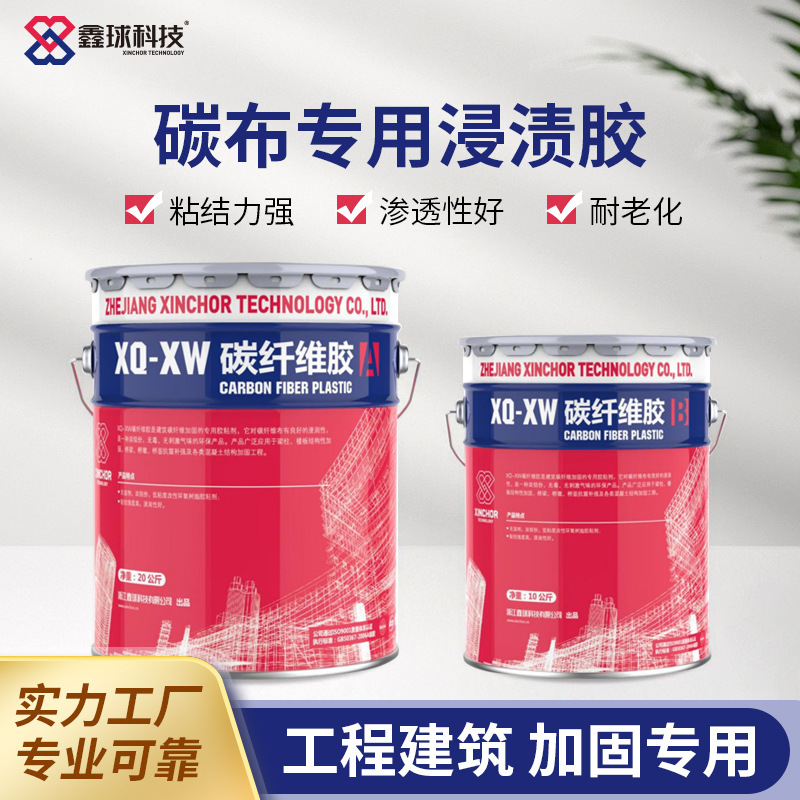
1. CFRP Fabric Wrapping (Wet Lay-Up System)Dry carbon fiber fabric is applied to the prepared concrete surface and saturated with impregnation resin on site. This is the most versatile method — the fabric conforms to any shape, including curved surfaces, columns, and irregular geometries.
- Our 300g/m2 unidirectional carbon fiber fabric is the standard product for beam shear strengthening and column confinement
- Tensile strength: 3,400 MPa or above (fabric); 60--80 MPa design strength after impregnation (per ACI 440.2R)
- Typical applications: column confinement for seismic retrofit, beam shear strengthening, slab flexural strengthening, blast mitigation
- Installation rate: An experienced crew can apply 15--25 m2 of fabric per day per worker
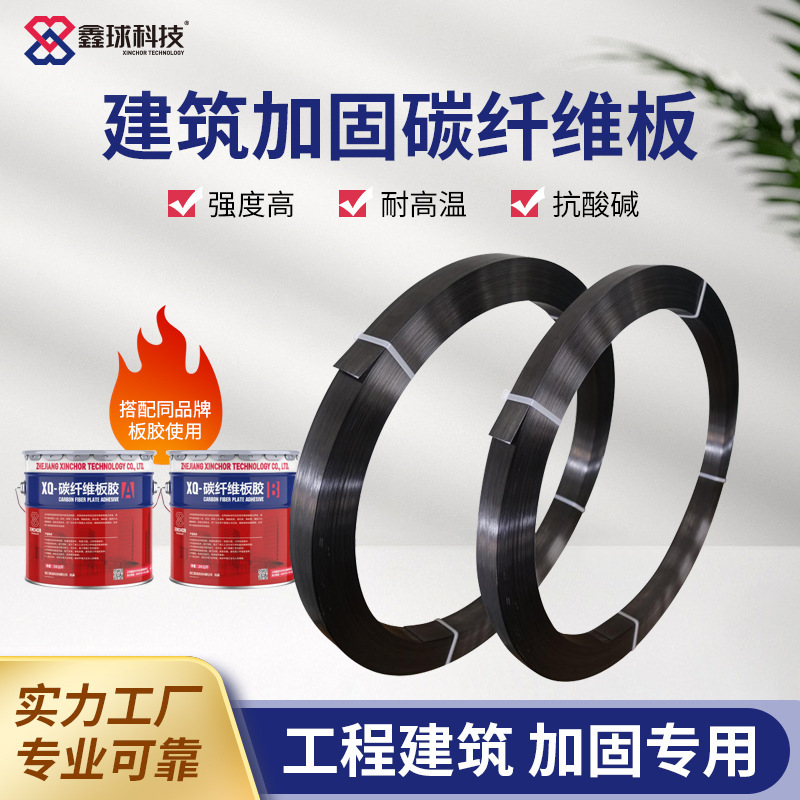
Factory-manufactured CFRP plates are bonded to the tension face of beams and slabs using structural adhesive. The factory-controlled fiber volume fraction (65%+) ensures consistent quality.
- Our standard plates: 1.2 mm and 1.4 mm thickness, 50--150 mm widths
- Tensile strength: 2,400 MPa or above; elastic modulus: 165 GPa or above
- Best for beam soffit flexural strengthening — faster installation than fabric because there is no on-site impregnation step
- Bond line thickness: 1--3 mm of CFRP plate bonding adhesive
FRP bars or strips are inserted into grooves cut into the concrete cover and bonded with epoxy. NSM provides better bond performance than externally bonded systems because the FRP is enclosed on three sides.
- Groove dimensions: typically 1.5 times the bar diameter wide and 1.5 times deep
- Less susceptible to debonding than surface-bonded plates
- Better fire and vandalism protection (embedded in concrete cover)
- Widely used in bridge deck strengthening where surface-mounted systems are vulnerable to traffic damage
When to Choose Fabric vs Plate vs NSM
| Criterion | CFRP Fabric | CFRP Plate | NSM Bars/Strips |
|---|---|---|---|
| Surface shape | Any (curved, irregular) | Flat only | Flat (needs grooves) |
| Primary strengthening mode | Shear, confinement, flexure | Flexure | Flexure |
| Installation speed | Moderate | Fast | Moderate |
| Bond performance | Good | Good | Best |
| Fire resistance | Lowest (exposed) | Low (exposed) | Best (embedded) |
| Aesthetic impact | Visible fabric layer | Visible plate strip | Nearly invisible |
| Cost per kN of strength added | Moderate | Lowest for flexure | Moderate |
Applications of FRP in Construction
Bridges
FRP is used in bridges in three ways: GFRP rebar in new bridge decks (eliminating chloride-induced corrosion from deicing salt), CFRP strengthening of existing bridge girders (the most common retrofit method worldwide), and all-FRP bridge decks (lightweight replacement decks for historic or load-restricted bridges).
The Canadian province of Quebec has mandated GFRP rebar in all new bridge decks since 2010. The Florida Department of Transportation allows GFRP rebar as an alternative to epoxy-coated steel in marine substructures per FDOT Standard Specifications Section 932.
Parking Structures
Parking garages are the single largest market for GFRP rebar in North America. The combination of deicing salt carried in by vehicles, standing water, and freeze-thaw cycling creates the most aggressive corrosion environment for embedded steel. A 2019 study by the National Research Council Canada (NRC) documented that GFRP-reinforced parking decks showed zero corrosion-related distress after 15 years in service, while adjacent steel-reinforced decks required $180/m2 in corrosion repairs.
Marine and Coastal Structures
Seawalls, wharves, jetties, tidal barriers, and desalination plant structures all benefit from FRP's corrosion immunity. In the Arabian Gulf, where chloride concentrations in concrete can reach 4--6% by weight of cement within 10 years, GFRP rebar with vinyl ester resin has become the specification of choice for new marine infrastructure.
Tunnels and Underground Structures
Tunnel lining segments reinforced with GFRP rebar are used at TBM (tunnel boring machine) breakthrough zones where the cutting head would damage steel reinforcement. CFRP fabric strengthening is used to upgrade existing tunnel linings to carry increased ground loads or to repair fire-damaged linings (as done in the Channel Tunnel after the 1996 and 2008 fires).
Seismic Retrofit
CFRP wrapping of columns and beam-column joints is the fastest and least disruptive method for seismic retrofit of existing buildings. Two to three layers of unidirectional carbon fiber fabric can increase column ductility by 200--500% (per ACI 440.2R-17), allowing non-ductile older concrete frames to survive design-level earthquakes without collapse.
Design Standards and Codes for FRP in Construction
Engineers need code backing before specifying FRP. Here are the governing standards:
| Standard | Scope | Jurisdiction |
|---|---|---|
| ACI 440.1R-15 | Guide for design of concrete reinforced with FRP bars | USA (ACI) |
| ACI 440.2R-17 | Guide for design of externally bonded FRP systems for strengthening concrete | USA (ACI) |
| ACI 440.11-22 | Building code requirements for FRP reinforcement (first mandatory code) | USA (ACI) |
| CSA S806-12 (R2021) | Design and construction of building structures with FRP | Canada (CSA) |
| CSA S807-19 | Specification for FRP bars, grids, and plates | Canada (CSA) |
| fib Bulletin 14 | Externally applied FRP reinforcement for RC structures | International (fib) |
| fib Bulletin 40 | FRP reinforcement in RC structures | International (fib) |
| ISIS Canada Design Manuals | FRP for infrastructure (4 manuals covering bars, sheets, durability, seismic) | Canada |
| GB 50608-2020 | Technical code for infrastructure application of FRP composites | China |
| GB/T 26745 | Basalt fiber rebar for concrete reinforcement | China |
| TR 55 (Concrete Society) | Design guidance for strengthening concrete structures using FRP | UK |
| CNR-DT 200 R1/2013 | Guide for design of externally bonded FRP systems | Italy |
FRP Pricing Guide — 2026 Market Rates
Pricing transparency is rare in the FRP industry. Here are current factory-direct price ranges based on our own product line and industry benchmarks:
FRP Rebar Pricing
| Product | Specification | Price Range (USD) |
|---|---|---|
| GFRP Rebar No. 3 (10mm) | E-glass / vinyl ester | $0.80--$1.50 per linear foot |
| GFRP Rebar No. 4 (13mm) | E-glass / vinyl ester | $1.10--$2.00 per linear foot |
| GFRP Rebar No. 5 (16mm) | E-glass / vinyl ester | $1.50--$3.00 per linear foot |
| GFRP Rebar No. 6 (19mm) | E-glass / vinyl ester | $2.00--$4.00 per linear foot |
| BFRP Rebar 10mm | Basalt / epoxy | $0.90--$1.80 per linear foot |
| CFRP Rebar 10mm | Carbon / epoxy (special order) | $4.00--$8.00 per linear foot |
CFRP Strengthening Products Pricing
| Product | Specification | Price Range (USD) |
|---|---|---|
| CFRP Fabric 200g/m2 (12K) | Unidirectional, width 200--500mm | $15--$35 per m2 |
| CFRP Fabric 300g/m2 (12K) | Unidirectional, width 200--500mm | $20--$45 per m2 |
| CFRP Fabric 600g/m2 | Unidirectional, width 200--500mm | $35--$60 per m2 |
| CFRP Plate 1.2mm x 50mm | Pultruded, modulus 165 GPa+ | $15--$30 per linear meter |
| CFRP Plate 1.4mm x 100mm | Pultruded, modulus 165 GPa+ | $25--$40 per linear meter |
| CFRP Impregnation Resin | Two-component epoxy, 1 kg kit | $8--$15 per kg |
| CFRP Plate Bonding Adhesive | Two-component thixotropic epoxy | $10--$18 per kg |
How to Select the Right FRP System for Your Project
Follow this decision flowchart:
Step 1: Define the application- New construction reinforcement (rebar replacement) → GFRP or BFRP
- Existing structure strengthening → CFRP (fabric or plate)
- Impact/blast protection → AFRP
- Marine/chloride exposure → GFRP rebar with vinyl ester resin (not polyester)
- Alkaline exposure (pH > 12) → BFRP or GFRP with ECR-glass
- Electrical insulation required → GFRP or AFRP (not CFRP)
- USA: ACI 440.1R/440.2R, AASHTO LRFD Bridge Design
- Canada: CSA S806, ISIS Design Manuals
- China: GB 50608
- Europe: fib Bulletins + national annexes
- Service life under 30 years, no corrosion risk → steel is cheaper
- Service life 50+ years or corrosive environment → FRP almost always cheaper on a lifecycle basis
- Seismic retrofit of existing structure → CFRP is faster and less disruptive than any steel alternative
Frequently Asked Questions
Is FRP stronger than steel?
In tensile strength, yes. CFRP composites achieve 2,400--4,900 MPa versus 400--600 MPa for structural steel. However, FRP's elastic modulus varies widely: CFRP (230+ GPa) approaches steel (200 GPa), while GFRP (40--55 GPa) is only about one-quarter as stiff. FRP also lacks a yield plateau — it fails in a linear-elastic, brittle manner. So while FRP is "stronger" in terms of ultimate tensile capacity, steel is "tougher" in terms of energy absorption before failure. Design standards account for this by applying larger safety factors to FRP (typically 3.0--5.0 versus 1.5--1.7 for steel per ACI 440.1R).
How much does FRP rebar cost per foot?
GFRP rebar ranges from $0.80 to $4.00 per linear foot depending on diameter (No. 3 through No. 6). This is approximately 1.5--2.5 times the cost of equivalent-diameter uncoated steel rebar. Epoxy-coated steel narrows the gap to about 1.2--1.8 times. In corrosive environments with 75-year or 100-year design life, GFRP is the cheaper option on a lifecycle basis — see the parking garage case study above.
How long does FRP last in concrete?
FRP composites are immune to electrochemical corrosion, which is the primary degradation mechanism for steel in concrete. Properly manufactured GFRP rebar with vinyl ester resin has demonstrated service life projections exceeding 100 years based on accelerated aging tests per ASTM D7705. The Canadian Highway Bridge Design Code (CSA S6-19) assigns a durability factor of 0.75 for GFRP in moist conditions and 0.85 for dry conditions, implying confidence in long-term performance with appropriate design margins.
Can FRP rebar be bent on site?
No. FRP rebar cannot be field-bent because the cured thermoset resin matrix would crack and the fibers would break. All bent shapes (stirrups, hooks, L-bars, U-bars) must be factory-formed during manufacturing before the resin cures. This requires advance planning and accurate shop drawings. Straight bars can be cut to length on site using a diamond blade or abrasive wheel — do not use a torch or shear cutter.
What is the difference between FRP and CFRP?
FRP (Fiber Reinforced Polymer) is the broad category encompassing all fiber-reinforced polymer composites. CFRP (Carbon Fiber Reinforced Polymer) is a specific type of FRP where the reinforcing fiber is carbon. Other types include GFRP (glass), AFRP (aramid), and BFRP (basalt). In construction, "FRP" often defaults to GFRP when discussing rebar, and to CFRP when discussing structural strengthening — but the distinction matters for engineering design because their mechanical properties differ by a factor of 4--10 depending on the property.
Does FRP conduct electricity?
GFRP, AFRP, and BFRP are electrical insulators. CFRP is an electrical conductor (resistivity approximately 10-3 to 10-2 ohm-cm along the fiber direction). This has two implications: (1) CFRP should not be placed in direct contact with aluminum or steel in the presence of moisture, as galvanic corrosion of the metal will occur; (2) GFRP, not CFRP, is required for MRI rooms, electrical substations, and radar-transparent structures.
What design standard should I use for FRP in construction?
For new construction with FRP rebar: ACI 440.1R-15 (USA), CSA S806-12 (Canada), or GB 50608-2020 (China). For external strengthening with bonded FRP: ACI 440.2R-17 (USA), fib Bulletin 14 (international), TR 55 (UK), or GB 50608-2020 (China). The landmark ACI 440.11-22 is the first mandatory (not just guideline) code for FRP reinforcement in the USA, published in 2022 and referenced by ACI 318-25.
---
Related Guides:- CFRP Bridge Strengthening — Complete Installation Guide
- Carbon Fiber Beam Strengthening Methods
- Seismic Retrofit with Carbon Fiber — Methods and Design
- Is Carbon Fiber Stronger Than Steel? Data-Driven Answer
- FRP Rebar vs Steel Rebar Comparison
*XINCHOR manufactures CFRP fabrics (200--600 g/m2), pultruded CFRP plates, impregnation resins, plate bonding adhesives, and structural epoxy systems for concrete strengthening projects worldwide. With over 20 years of composite production experience, we supply contractors and engineering firms in 40+ countries. Every batch ships with a certificate of analysis and full test documentation per ASTM and GB standards. Contact XINCHOR for product datasheets, test reports, or project pricing — WhatsApp: +86 133 3618 3725 | Email: [email protected]*