
Project Overview
This project involved structural reinforcement of a public rental housing development in Fuyang District, Hangzhou. As a government-funded residential complex intended for high-occupancy use, the buildings required the highest standards of structural safety.
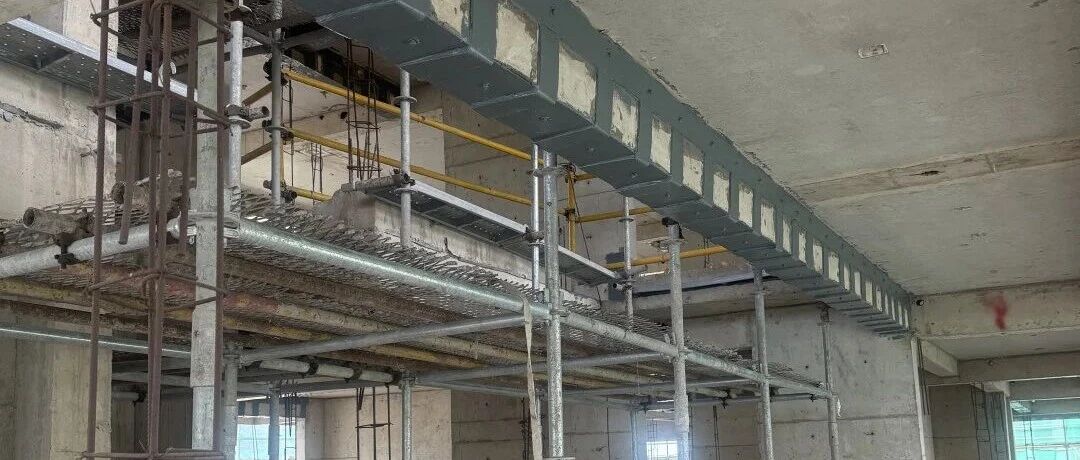
The reinforcement scope covered floor slabs and primary and secondary beam members, using XINCHOR carbon fiber fabric, carbon fiber adhesive, and structural bonding adhesive (steel plate bonding adhesive). The work was executed strictly in accordance with strengthening design drawings and GB 50367-2013 standards.
Why Reinforcement Was Needed
High occupancy safety standards. Public rental housing serves large populations. The consequences of structural failure would be severe, making proactive reinforcement essential where beam and slab members showed load capacity concerns. Fixed architectural dimensions. As the building was under construction with interior dimensions and floor heights already established, any reinforcement method had to add minimal bulk. Both steel plate bonding and CFRP application add less than 10mm to member dimensions, far less than section enlargement alternatives. Targeted structural deficiencies. The structural review identified specific issues: some floor slabs had insufficient bending capacity, while certain primary and secondary beams needed additional shear and flexural reinforcement. Rather than over-engineering the entire structure, the two methods were applied precisely where needed.Method 1: Steel Plate Bonding
Steel plates were bonded to the concrete surface of floor slabs and beams using XINCHOR structural adhesive, supplemented by mechanical anchor bolts for added reliability. The steel plates and original concrete form a composite section that shares the structural load.
Floor slab application — Steel plates bonded to the slab soffit increase bending capacity and distribute concentrated loads. Beam application — U-shaped steel wraps around beam sides and bottom provide comprehensive reinforcement:- Bottom plates resist bending tension
- Side plates provide shear reinforcement
- The U-wrap configuration confines the concrete core, restraining crack propagation
Steel Plate Bonding Installation
Method 2: Carbon Fiber Fabric Reinforcement
For members where CFRP was more appropriate, carbon fiber fabric with XINCHOR XQ-XW adhesive was used:
Beam bottom — CFRP fabric bonded to the tension face increases flexural capacity. U-wrap on beam sides — Carbon fiber fabric applied in a U-configuration around beams enhances shear resistance and confines the concrete, restraining crack development.CFRP Application Process
Material Selection Rationale
The dual-method approach was chosen deliberately. Each method has strengths suited to different structural members:
| Criterion | Steel Plate Bonding | CFRP Fabric |
|---|---|---|
| Shear capacity increase | Excellent — steel provides high shear resistance | Good — U-wraps effective for moderate shear |
| Flexural capacity increase | Very good | Very good |
| Weight added | Moderate (steel is heavy) | Minimal |
| Installation speed | Moderate — requires pressing fixtures | Fast — roller application |
| Best suited for | Heavily loaded beams and slabs | Secondary beams, moderate loads |
Project Results
All reinforcement work has been completed successfully. On-site material testing and structural inspections confirmed that all XINCHOR products met or exceeded the requirements of the applicable Chinese standards. Bond strength pull-off tests on both CFRP and steel plate applications achieved target values with correct failure modes.
FAQ
Q: Why use two different reinforcement methods on the same building? A: Different structural members have different load requirements and failure modes. Steel plate bonding provides maximum capacity increase for heavily loaded primary beams, while CFRP is more efficient for secondary members and slabs where the capacity shortfall is moderate. Using both methods optimizes material cost and installation efficiency. Q: Is steel plate bonding still effective in humid conditions? A: Yes, when properly installed with high-quality structural adhesive. XINCHOR structural adhesive is formulated for excellent moisture resistance. The critical factor is ensuring the concrete surface is dry at the time of bonding — surface moisture content should be below 4%. After curing, the adhesive bond is unaffected by humidity. Q: How do you verify the quality of structural adhesive bonds on site? A: Bond quality is verified through pull-off testing per GB/T 50550. A test dolly is bonded to the reinforcement surface and pulled until failure. The failure should occur in the concrete substrate (not at the adhesive interface), confirming the bond strength exceeds the concrete tensile strength. XINCHOR materials consistently achieve substrate failure at loads above 2.5 MPa.---
Related Resources
- Structural Adhesive for Metal Bonding: Epoxy for Steel-to-Concrete — Complete guide to steel plate bonding adhesive selection and application.
- Carbon Fiber Beam Strengthening: Design & Methods — CFRP beam strengthening design considerations and installation procedures.
- Concrete Repair Mortar: Types & Strength Comparison — Repair mortar selection for concrete surface restoration.
- Steel Bonding System Products — XINCHOR structural adhesive, edge seal, and grouting adhesive.
- Carbon Fiber Reinforcement Products — Carbon fiber fabric and plates for structural strengthening.