
Project Background
A large industrial factory in Ningbo, Zhejiang Province required floor slab strengthening to meet increased production load requirements. The original concrete floor slabs showed inadequate load-bearing capacity under long-term service conditions, with risks of deflection and cracking that could compromise production safety.
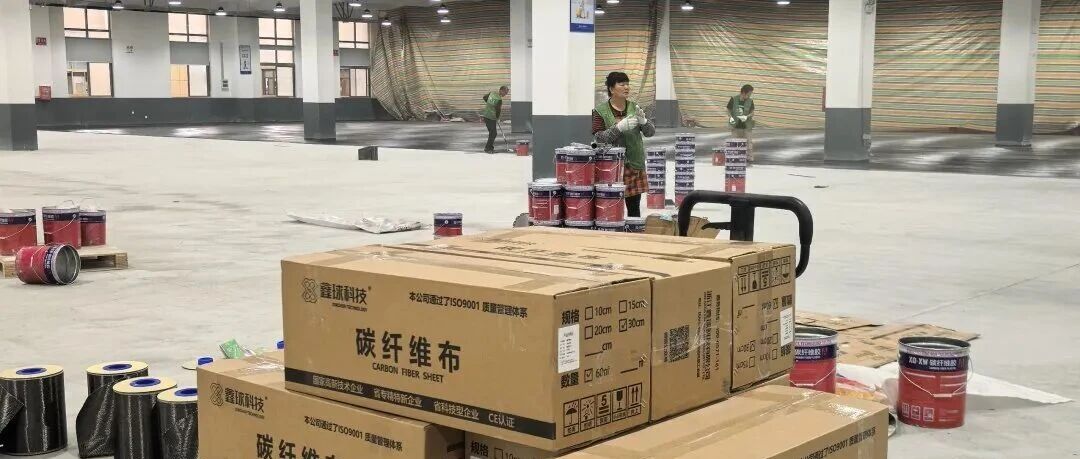
The project used XINCHOR carbon fiber fabric and XQ-XW carbon fiber adhesive for a complete bonded reinforcement system, following the design specifications of GB 50367-2013 (Code for Design of Strengthening Concrete Structure).
Why Carbon Fiber for Floor Slabs?
When evaluating strengthening options for large-area floor slabs, carbon fiber fabric offered clear advantages over alternatives:
Ultra-lightweight — Carbon fiber fabric adds virtually zero dead load to the slab. This is critical because floor slabs are already carrying their design load; adding heavy reinforcement materials would worsen the overload problem. Minimal thickness — The completed CFRP system is under 2mm thick, preserving the factory floor-to-ceiling clearance. In a manufacturing facility, every centimeter of headroom matters for equipment access, overhead cranes, and ventilation systems. Corrosion and aging resistance — Factory environments often involve chemicals, moisture, and temperature variations. CFRP materials maintain their structural properties in these conditions, providing long-term reinforcement durability. Fast installation over large areas — CFRP fabric application uses a simple wet lay-up process that allows continuous application across large slab areas, keeping the construction period manageable and minimizing production downtime.How CFRP Strengthens Floor Slabs
The reinforcement principle is straightforward: carbon fiber fabric, bonded to the tensile face of the concrete slab with XINCHOR XQ-XW impregnation adhesive, creates a composite section.
When the slab carries load and the bottom fibers go into tension, the carbon fiber fabric — with tensile strength exceeding 3,400 MPa — shares the tensile load with the concrete. This limits crack opening, reduces slab deflection, and effectively increases the slab bending capacity.
For this project, unidirectional carbon fiber fabric was applied to the bottom surface of the floor slabs in the primary tensile direction, following the pattern specified in the structural engineer strengthening drawings.
Materials Specification
| Material | Product | Key Property |
|---|---|---|
| Carbon Fiber Fabric | XINCHOR 300g/m² Unidirectional | Tensile strength ≥ 3,400 MPa |
| Impregnation Adhesive | XINCHOR XQ-XW | Shear strength ≥ 14 MPa |
| Primer | XINCHOR Concrete Primer | Penetrating seal coat |
Project Outcome
The reinforcement has been completed with all materials meeting testing standards. Post-installation bond pull-off tests confirmed adhesion exceeding code requirements, with failure occurring in the concrete substrate — the correct failure mode indicating the adhesive bond exceeded the concrete tensile strength.
The factory is now operating under full production loads with the reinforced floor slabs performing as designed.
FAQ
Q: How much additional load capacity does CFRP provide to floor slabs? A: The capacity increase depends on the original slab design, the amount of CFRP applied, and the loading configuration. Typically, one to two layers of 300g/m² carbon fiber fabric increases the slab bending capacity by 20–40%. The exact increase must be calculated by a structural engineer for each specific case. Q: Can CFRP reinforcement be applied while the factory continues operating? A: In many cases, yes. CFRP installation is relatively quiet, produces no dust (unlike concrete cutting), and can be staged to reinforce one bay at a time while adjacent areas remain in production. However, the newly reinforced area needs 7 days of curing before receiving full design loads. Q: Is special equipment needed for CFRP floor slab reinforcement? A: No heavy equipment is required. The main tools are a concrete grinder for surface preparation, rollers for adhesive application, and standard hand tools. This is one of the key advantages over methods that require formwork, concrete pumping, or welding equipment.---
Related Resources
- Why Ultra-Thin Carbon Fiber Fabric Delivers Effective Structural Reinforcement — Material science behind 0.111mm-0.167mm CFRP fabric performance.
- CFRP Strengthening Systems: Applications Guide — Complete guide to carbon fiber reinforcement system selection and design.
- Two-Part Epoxy Adhesive Guide — Technical data on the epoxy resin systems used for CFRP impregnation.
- Carbon Fiber Reinforcement Products — XINCHOR 300g/m² and 200g/m² unidirectional carbon fiber fabric.