
CFRP in Modern Structural Rehabilitation
Carbon Fiber Reinforced Polymer (CFRP) has become the dominant material for strengthening existing concrete, masonry, and steel structures worldwide. Its combination of extraordinary tensile strength (3,400 MPa or higher for unidirectional fabric), low weight (200 to 300 g/m² for standard fabric), and corrosion immunity makes it the material of choice for engineers dealing with structures that need more capacity without more dead load.
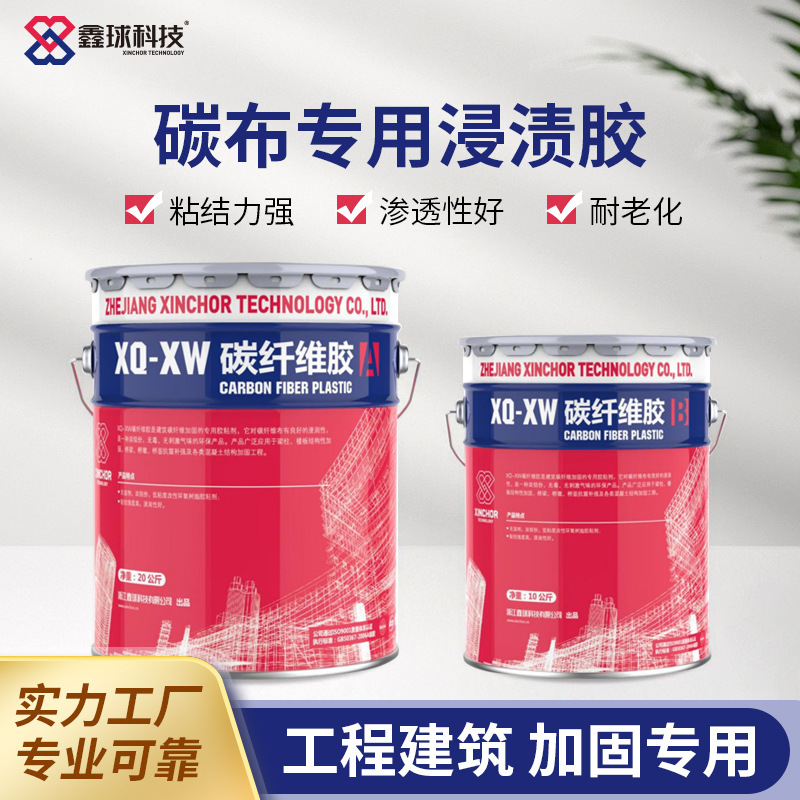
The global CFRP construction market is projected to reach USD 3.2 billion by 2028, driven by aging infrastructure in developed countries and rapid urbanization in developing regions. As a manufacturer producing CFRP systems since 2005 — including fabrics, plates, adhesives, and impregnation resins — we supply complete strengthening packages to contractors, engineers, and distributors in over 40 countries.
This guide covers the four main CFRP strengthening methods, their design principles, and when to use each one.
The Four CFRP Strengthening Systems
1. Wet Lay-Up CFRP Fabric System
The wet lay-up system is the most versatile and widely used CFRP strengthening method. Dry carbon fiber fabric is saturated with epoxy resin on site and applied directly to the prepared concrete surface, where it cures to form a rigid composite laminate.
System components:- Unidirectional carbon fiber fabric (our XQ-CF series: 200g/m², 300g/m², or 600g/m²)
- Primer (penetrating epoxy, XQ-PR — ensures bond to concrete pore structure)
- Leveling putty (XQ-LP — fills surface irregularities up to 5 mm)
- Impregnation/laminating resin (XQ-IR — saturates the fabric and bonds it to the substrate)
| Property | Specification |
|---|---|
| Tensile strength of fiber | ≥ 3,400 MPa |
| Elastic modulus of fiber | ≥ 230 GPa |
| Design thickness per layer | 0.111 mm |
| Fiber content by volume | 25–35% (wet lay-up) |
| Laminate tensile strength | ≥ 850 MPa (based on nominal thickness) |
| Laminate elastic modulus | ≥ 60 GPa (based on nominal thickness) |
- Column confinement and ductility improvement (circular and rectangular columns)
- Beam shear strengthening (U-wrap or full wrap)
- Slab flexural strengthening (bonded to soffit)
- Curved or irregular surface geometries
- Seismic retrofit of non-ductile columns (per ACI 440.2R)
2. Pultruded CFRP Plate System
CFRP plates are factory-manufactured strips with controlled fiber volume fraction (65% or higher), producing consistent mechanical properties that eliminate the variability of on-site wet lay-up.
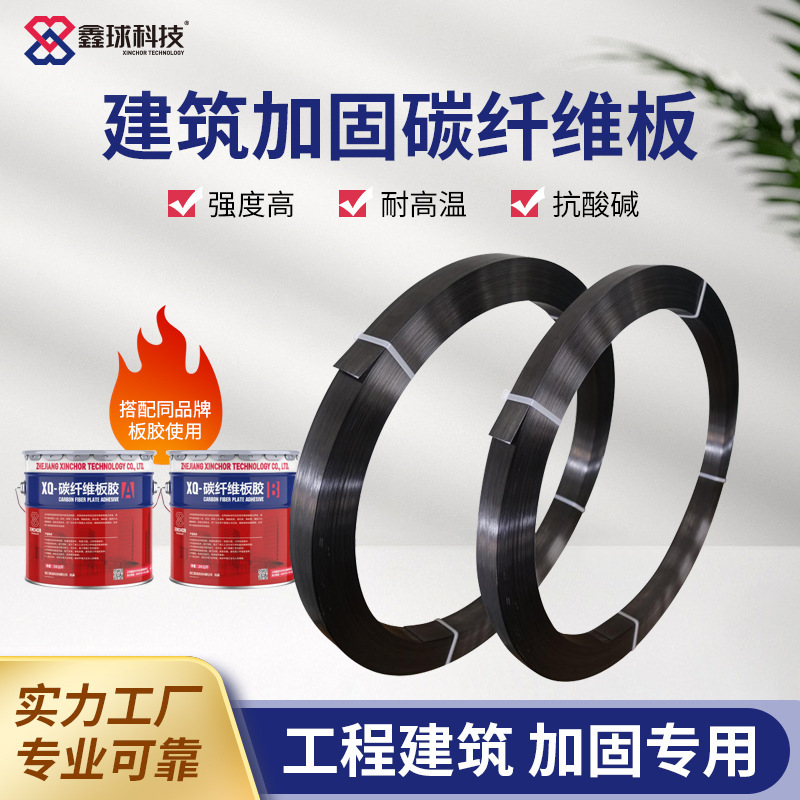 Mechanical properties:
| Property | 1.2 mm Plate | 1.4 mm Laminate |
|---|---|---|
| Tensile strength | ≥ 2,400 MPa | ≥ 2,400 MPa |
| Elastic modulus | ≥ 160 GPa | ≥ 165 GPa |
| Fiber volume fraction | ≥ 65% | ≥ 65% |
| Available widths | 50, 80, 100 mm | 50, 80, 100 mm |
| Maximum length | 50 m continuous | 50 m continuous |
- Beam soffit flexural strengthening (the primary application)
- Slab soffit reinforcement for increased load rating
- Bridge girder upgrade for heavier traffic loads
- Industrial structures requiring additional bending capacity
3. Near-Surface Mounted (NSM) CFRP Strips
NSM is a relatively newer technique where CFRP strips or bars are embedded in grooves cut into the concrete cover. This provides several advantages over externally bonded systems:
- Higher bond efficiency: The strip is enclosed in adhesive on three sides instead of one, dramatically increasing bond capacity
- Better fire resistance: The concrete cover protects the CFRP from direct flame exposure
- Vandalism and impact protection: The CFRP is not exposed to accidental damage
- Aesthetic advantage: Invisible after groove filling and surface finishing
4. Prestressed CFRP System
Prestressed CFRP applies the strengthening material under tension, which actively reduces the existing stress in the reinforcement and improves serviceability (deflection and crack width control) in addition to increasing ultimate capacity.
Advantages over non-prestressed CFRP:- Utilizes 60 to 80% of the CFRP's tensile strength (non-prestressed systems typically use only 30 to 50% at ultimate)
- Reduces existing steel stress, extending fatigue life
- Closes existing cracks and reduces deflection under service load
- More efficient use of expensive CFRP material
Design Principles for CFRP Strengthening
ACI 440.2R and GB 50367: The Two Key Standards
CFRP strengthening design follows two major international standards:
| Aspect | ACI 440.2R (US/International) | GB 50367 (China) |
|---|---|---|
| Design philosophy | Strength reduction factors | Partial safety factors |
| Environmental reduction factor (CE) | 0.85 for interior, 0.65 for exterior | Similar through durability factor |
| Debonding strain limit | 0.41√(fc'/nEftf) | Specified per failure mode |
| Maximum strengthening limit | 40% increase in flexural capacity | Varies by strengthening ratio |
| Fire design | Must satisfy un-strengthened capacity for fire loading | Fireproofing requirements specified |
Failure Modes
CFRP-strengthened members can fail in several modes, and the design must check all of them:
Material Selection Guide
| Criterion | Wet Lay-Up Fabric | Pultruded Plate | NSM Strip |
|---|---|---|---|
| Surface geometry | Curved, irregular, any shape | Flat surfaces only | Flat surfaces with adequate cover |
| Strengthening type | Flexural + shear + confinement | Flexural only | Flexural only |
| Number of layers needed | 1–5 layers typical | Single layer (increase width if needed) | Single strip per groove |
| Installation speed | Moderate (3–4 hours per bay) | Fast (1–2 hours per bay) | Moderate (groove cutting adds time) |
| Quality consistency | Depends on installer skill | Factory-controlled, very consistent | Good (adhesive fill quality critical) |
| Fire protection | Requires coating or insulation | Requires coating or insulation | Inherently protected by concrete cover |
| Cost per kN of capacity | Moderate | Moderate to high | Moderate |
| Aesthetics after installation | Visible surface layer | Visible thin strip | Invisible (embedded) |
Installation Quality Control
Quality control for CFRP installations must verify three things:
1. Substrate quality: Pull-off test on prepared concrete surface — minimum 1.5 MPa per ACI 440.2R, minimum 2.0 MPa per EN 1504-4. If the concrete is too weak, surface repair with our polymer-modified mortar is required before CFRP application. 2. Laminate quality: For wet lay-up, check the fiber-to-resin ratio by weighing fabric and resin consumption. The cured laminate should have a resin content of 40 to 50% by weight (corresponding to 25 to 35% fiber volume fraction for standard carbon fabrics). 3. Bond quality: Tap testing (acoustic sounding) of the cured CFRP surface — a sharp, clear sound indicates good bond; a dull, hollow sound indicates a void or debond. Any debonded area larger than 1,600 mm² (approximately 40 mm diameter) requires repair by resin injection through the CFRP layer.FAQ
Q: How long does CFRP strengthening last? A: CFRP materials do not corrode, rust, or fatigue under normal loading. Design codes assume a minimum 50-year service life for properly installed CFRP systems. The critical factor is the adhesive bond — UV exposure and thermal cycling can degrade the epoxy adhesive if left unprotected. We recommend a protective coating (our XQ-PC protective coating) for all exterior CFRP installations. Q: Can CFRP strengthen a member that has already been repaired with steel plates? A: Yes. CFRP can be bonded over existing steel plate repairs (provided the steel surface is blast-cleaned to Sa 2.5 and the adhesive is suitable for steel bonding). It can also replace deteriorated steel plates — the CFRP will not corrode, eliminating the recurring maintenance problem that likely prompted the replacement. Q: What is the maximum strengthening ratio with CFRP? A: ACI 440.2R limits the flexural capacity increase to 40% of the existing capacity to prevent brittle failure. In practice, 20 to 30% increase is the typical design range. For shear strengthening, the CFRP contribution can exceed the existing concrete shear capacity, but the total shear capacity is still limited by the diagonal compression strut capacity. Q: Does CFRP strengthening require building permits? A: In most jurisdictions, structural strengthening that changes the load-carrying capacity requires engineering review and building department approval. The design must be prepared by a licensed structural engineer with CFRP design experience. We provide material test certificates and design support to assist the engineer of record. Q: Can CFRP be applied to masonry structures? A: Yes. CFRP fabric strengthening is increasingly used for unreinforced masonry (URM) walls in seismic zones. The fabric is bonded to one or both faces of the wall to provide out-of-plane bending and in-plane shear resistance. Surface preparation for masonry requires repointing deteriorated mortar joints and applying a leveling coat before CFRP application.Conclusion
CFRP strengthening systems offer unmatched versatility for structural rehabilitation. Wet lay-up fabric handles complex geometries and multi-mode strengthening. Pultruded plates provide fast, consistent flexural upgrades. NSM strips deliver concealed reinforcement with superior bond performance. Prestressed CFRP maximizes material efficiency for heavily loaded members.
View our complete CFRP product catalog or request a project consultation to determine the optimal CFRP system for your structure.