
Two Grout Families, One Critical Choice
Every structural grouting application — filling the gap between a machine base and its foundation, anchoring equipment bolts, grouting post-tensioning ducts, or consolidating concrete — comes down to one decision: cementitious grout or epoxy grout?
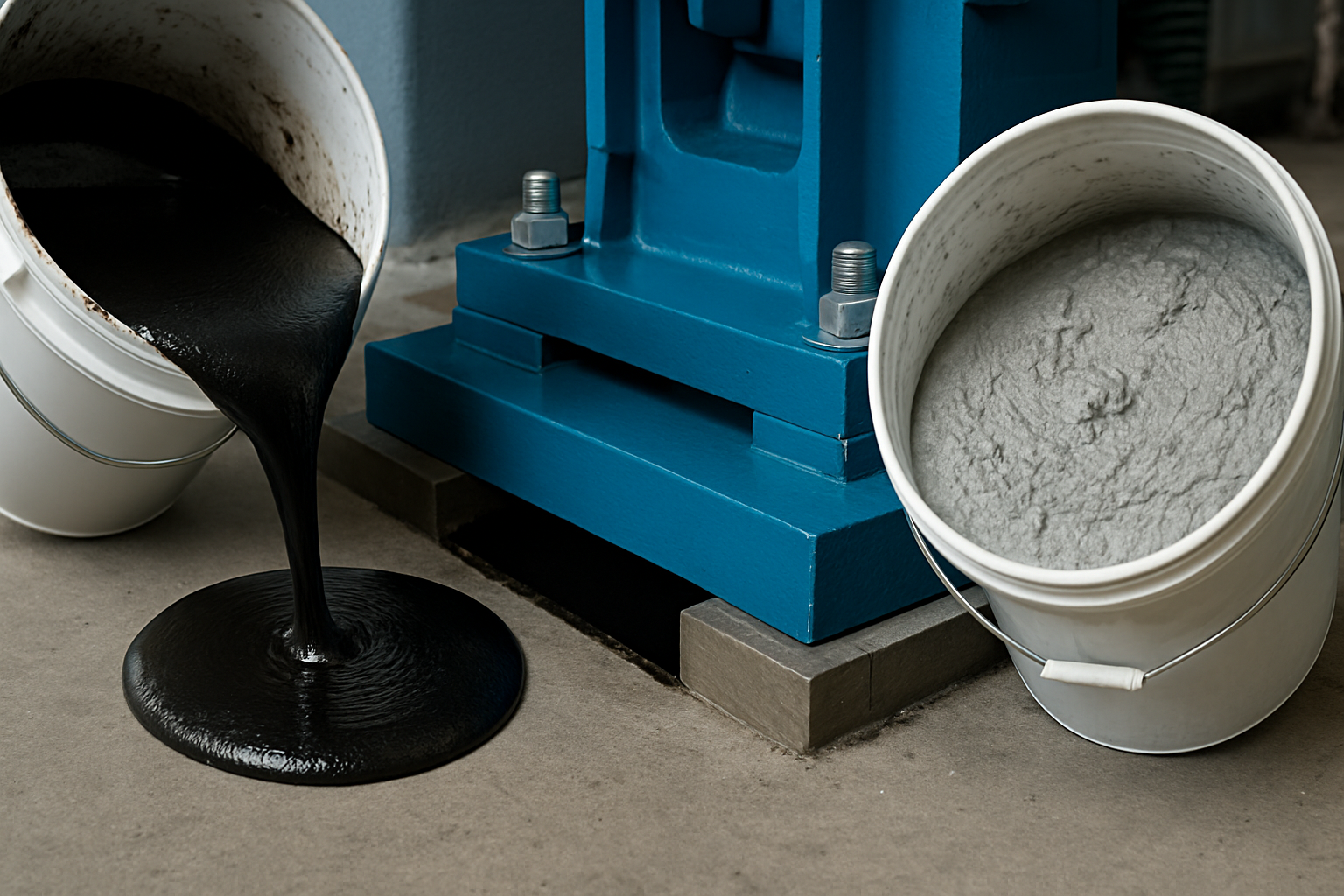
The answer depends on five variables: the load magnitude and type (static vs dynamic), the chemical environment, the temperature conditions, the gap geometry, and the budget. Getting this decision wrong does not just cost money — it causes machine vibration damage, anchor bolt loosening, foundation degradation, and unplanned shutdowns that can cost hundreds of thousands of dollars.
As a manufacturer producing both cementitious and epoxy grout formulations for infrastructure, industrial, and energy sector projects, we supply both product families and have no bias toward either. This guide presents the engineering data you need to make the right choice for your specific application.
What Is Cementitious Grout?
Cementitious grout is a pre-blended mixture of Portland cement, graded mineral fillers, chemical admixtures (superplasticizer, expansion agent, viscosity modifier), and sometimes polymer modifiers. On site, only water is added — the pre-blended formulation ensures consistent quality regardless of the mixing operator.
The defining characteristic of structural cementitious grout is non-shrink behavior: the grout maintains its volume or exhibits slight expansion (0.02 to 0.05%) during the plastic and hardening phases. This ensures full contact between the grout and the substrate — eliminating the gaps and voids that cause load concentration, vibration resonance, and progressive deterioration.
Our cementitious grout product range:| Product | Compressive Strength (28d) | Flow Spread | Max Aggregate | Expansion | Application |
|---|---|---|---|---|---|
| XQ-GR-NS (Non-Shrink) | ≥ 60 MPa | ≥ 300 mm | 2 mm | 0.02–0.05% | General machinery bases, anchor bolts |
| XQ-GR-HS (High-Strength) | ≥ 80 MPa | ≥ 280 mm | 1.5 mm | 0.01–0.03% | Heavy machinery, precision equipment |
| XQ-GR-FS (Fast-Set) | ≥ 40 MPa (4h) / ≥ 60 MPa (28d) | ≥ 300 mm | 2 mm | 0.02–0.05% | Emergency repairs, cold weather |
| XQ-GR-UF (Ultra-Fine) | ≥ 50 MPa | ≥ 350 mm | 0.3 mm | 0.01–0.03% | Post-tensioning ducts, narrow gaps |
| XQ-GR-UW (Underwater) | ≥ 45 MPa | ≥ 280 mm | 2 mm | 0.02–0.04% | Marine, submerged applications |
What Is Epoxy Grout?
Epoxy grout is a 100% resin system — there is no cement, no water, and no aggregate larger than fine mineral filler. It consists of three components: epoxy resin (Part A), hardener (Part B), and graded mineral filler (Part C). All three are mixed together on site to produce a self-leveling, zero-shrinkage grouting material.
The defining characteristics of epoxy grout are zero shrinkage (not just "non-shrink" — literally zero volume change), chemical resistance (resistant to acids, alkalis, solvents, and hydrocarbons that would destroy cementitious grout), and high bond strength to both steel and concrete.
Our epoxy grout:| Product | Compressive Strength | Tensile Strength | Bond to Steel | Bond to Concrete | Chemical Resistance |
|---|---|---|---|---|---|
| XQ-GZ (Epoxy Grouting Adhesive) | ≥ 90 MPa | ≥ 30 MPa | ≥ 12 MPa | ≥ 3.5 MPa | Excellent (acids, alkalis, solvents) |
The Complete Comparison: 20 Properties Head-to-Head
This is the most detailed cementitious grout vs epoxy grout comparison table available from any manufacturer. All values are from our own laboratory testing.
| Property | Cementitious Non-Shrink Grout (XQ-GR-NS) | Epoxy Grout (XQ-GZ) | Winner |
|---|---|---|---|
| Compressive strength (1 day) | ≥ 20 MPa | ≥ 40 MPa | Epoxy |
| Compressive strength (7 days) | ≥ 45 MPa | ≥ 80 MPa | Epoxy |
| Compressive strength (28 days) | ≥ 60 MPa | ≥ 90 MPa | Epoxy |
| Tensile strength | 3–5 MPa | ≥ 30 MPa | Epoxy (6x) |
| Flexural strength | 8–12 MPa | 35–45 MPa | Epoxy (4x) |
| Bond to concrete | 1.5–2.5 MPa | ≥ 3.5 MPa | Epoxy |
| Bond to steel | 1.0–2.0 MPa (mechanical interlock) | ≥ 12 MPa (chemical bond) | Epoxy (6x) |
| Shrinkage | 0 to +0.05% (non-shrink) | 0.00% (true zero) | Epoxy (marginal) |
| Thermal expansion coefficient | 10–12 × 10⁻⁶/°C (matches concrete) | 25–35 × 10⁻⁶/°C | Cementitious |
| Service temperature range | -40 to 80°C | -40 to 60°C (above Tg: softening) | Cementitious |
| Glass transition temp (Tg) | N/A (ceramic material) | 55–65°C | Cementitious |
| Chemical resistance — acids | Poor (Portland cement dissolves in acid) | Excellent | Epoxy |
| Chemical resistance — alkalis | Good | Excellent | Epoxy |
| Chemical resistance — solvents | Good (inorganic, unaffected) | Good to excellent | Tie |
| Chemical resistance — hydrocarbons | Moderate (absorbs oil, stains) | Excellent (non-porous) | Epoxy |
| Fire resistance | Excellent (non-combustible, A1/A2) | Poor (combustible, generates smoke) | Cementitious |
| Creep under sustained load | Low (ceramic behavior) | Higher (viscoelastic above 30% Tg) | Cementitious |
| Vibration damping | Moderate | High (polymer absorbs energy) | Epoxy |
| Application temperature | 5–35°C | 10–35°C | Cementitious |
| Pot life at 25°C | 30–60 minutes | 20–40 minutes | Cementitious |
| Water requirement | 12–14% by weight | None (100% solids) | Tie |
| Density (mixed) | 2,200–2,400 kg/m³ | 1,800–2,000 kg/m³ | Depends on application |
| Cost per m³ (material) | $300–600 | $2,000–4,000 | Cementitious (5–8x cheaper) |
| Shelf life | 12 months | 12 months | Tie |
| VOC emissions | Zero | Low to moderate | Cementitious |
| Curing requirement | Moist curing 7 days | No curing required | Epoxy |
The Decision Tree: Which Grout for Your Application
Rather than presenting a complex matrix, here is a simple decision tree based on two decades of grouting project experience:
Question 1: Is the grout exposed to acids, oils, solvents, or aggressive chemicals?- YES → Epoxy grout (cementitious grout will dissolve or deteriorate)
- NO → Continue to Question 2
- YES → Epoxy grout (cementitious grout cannot reliably fill gaps under 10 mm without segregation)
- NO → Continue to Question 3
- YES → Cementitious grout (epoxy softens above its Tg of 55–65°C)
- NO → Continue to Question 4
- YES → Cementitious grout (non-combustible)
- NO → Continue to Question 5
- YES → Cementitious grout (5–8x cheaper, adequate performance for standard applications)
- NO → Epoxy grout (when performance justifies the cost premium)
Application-Specific Recommendations
Machinery Base Grouting
This is the single largest grouting application by volume. The grout fills the gap (typically 25 to 75 mm) between the machine base plate and the concrete foundation, transferring static weight and dynamic (vibratory) loads uniformly to the foundation.
Standard rotating equipment (pumps, compressors, fans, generators up to 500 kW): Cementitious non-shrink grout (XQ-GR-NS). The 60 MPa compressive strength and non-shrink behavior are more than adequate. Cost savings of 70 to 80% compared to epoxy. High-precision or heavy dynamic equipment (turbines, large compressors, CNC machining centers, printing presses): Epoxy grout (XQ-GZ). The 90 MPa strength, true zero shrinkage, and superior vibration damping provide the dimensional stability that precision equipment demands. The higher cost is justified by reduced maintenance and longer machine life. Chemical process equipment (reactors, mixers, pumps in chemical plants): Epoxy grout. Even if the equipment is light-duty, acid or solvent spills will degrade cementitious grout within months.Anchor Bolt Grouting
When anchor bolts are set in oversized pockets or sleeves in a concrete foundation, the annular space around the bolt must be filled with grout to transfer load and prevent corrosion.
Recommendation: Cementitious non-shrink grout for almost all anchor bolt applications. The bolt pocket is typically 50 to 100 mm larger than the bolt, providing ample space for cementitious grout flow. Epoxy is unnecessary unless the anchor is in a chemical-exposure environment.For post-installed anchor bolts using adhesive (rather than grout), see our epoxy anchor adhesive products and epoxy anchors guide.
Post-Tensioning Duct Grouting
Post-tensioning ducts must be completely filled with grout to protect the tendons from corrosion and to develop bond in bonded post-tensioning systems. The grout must flow through long, narrow ducts (often 50+ meters) without segregation or bleed.
Recommendation: Cementitious ultra-fine grout (XQ-GR-UF). The 0.3 mm maximum particle size and high fluidity (flow spread ≥ 350 mm) ensure complete duct filling without blockage. Epoxy grout is never used for duct grouting — the thermal expansion mismatch would create destructive stresses in the duct.Underwater Grouting
Pile jackets, submerged machinery bases, dam repairs, and marine infrastructure require grout that resists washout when placed in water.
Recommendation: Cementitious underwater grout (XQ-GR-UW) with anti-washout admixture. For aggressive marine environments (chloride exposure, tidal zone), consider epoxy grout with underwater formulation — see our underwater epoxy grouting mortar.Mixing and Placement: Procedures for Both Systems
Cementitious Grout Mixing
Epoxy Grout Mixing
Performance Under Sustained and Dynamic Loading
For machinery foundations subject to continuous vibration (compressors, turbines, punch presses), the long-term behavior of the grout under cyclic loading is critical.
Cementitious grout behaves as a ceramic material under load — it has low creep, high stiffness, and maintains its dimensions indefinitely under sustained static load. However, under cyclic (vibratory) loading, micro-cracks can develop at the grout-steel interface over time, particularly if the initial installation had air voids or the grout was not properly consolidated. Epoxy grout is viscoelastic — it absorbs and dissipates vibratory energy rather than transmitting it rigidly. This vibration damping characteristic is why epoxy grout is preferred for precision rotating equipment. However, the viscoelastic behavior also means epoxy grout exhibits some creep under sustained static loads, particularly at temperatures above 30 to 40% of its Tg.| Loading Condition | Cementitious Grout Performance | Epoxy Grout Performance | Recommendation |
|---|---|---|---|
| Static compressive | Excellent (low creep) | Good (some creep above 40% Tg) | Either; cementitious for sustained high loads |
| Dynamic — low frequency (<10 Hz) | Good | Excellent (damping) | Epoxy for precision equipment |
| Dynamic — high frequency (>10 Hz) | Adequate | Excellent (damping) | Epoxy strongly preferred |
| Impact loading | Good (high compressive) | Excellent (energy absorption) | Epoxy |
| Thermal cycling | Excellent (compatible with concrete) | Risk of differential movement | Cementitious |
| Chemical exposure + load | Poor (chemical attack + load = rapid failure) | Excellent | Epoxy mandatory |
Cost Analysis: Total Installed Cost
Material cost tells only part of the story. The total installed cost includes material, labor, formwork, curing, and any special preparation or protection requirements.
| Cost Component | Cementitious Grout | Epoxy Grout | Notes |
|---|---|---|---|
| Material per m³ | $300–600 | $2,000–4,000 | Epoxy is 5–8x more expensive |
| Mixing labor | Standard | Requires trained operator | Epoxy mixing is more exacting |
| Formwork | Standard timber | Must be release-agent treated | Epoxy bonds permanently to untreated formwork |
| Curing | 7 days moist curing (labor cost) | No curing required | Epoxy saves curing labor |
| Surface preparation | Standard clean | Must be primer-coated for bond | Additional step for epoxy |
| Temperature control | Heat in cold weather | Heat components + substrate | Both need temperature management |
| Typical total installed cost per m³ | $500–1,200 | $3,000–6,000 | Cementitious is 3–5x cheaper installed |
Quality Control: Testing Procedures
For Cementitious Grout
- Flow test: Pour mixed grout into a flow cone (or onto flat plate), measure diameter — must meet specification (≥ 300 mm for XQ-GR-NS)
- Cube specimens: Cast 50 mm or 100 mm cubes from each batch, cure under same conditions as the grouted element, test compressive strength at 1, 7, and 28 days per EN 12190
- Expansion test: Place a dial gauge over freshly placed grout in a 100 mm mold and monitor height change for 24 hours — must show 0 to +0.05% expansion
- Temperature monitoring: For large pours, embed a thermocouple and monitor heat of hydration — peak temperature should not exceed 70 degrees Celsius
For Epoxy Grout
- Mix ratio verification: Weigh all three components before mixing — deviation from specified ratio reduces strength
- Gel time test: Pour a small sample into a cup and time from mixing to gel — must be within specified range (indicates correct mix and component temperature)
- Cube specimens: Cast 50 mm cubes, cure at ambient temperature, test at 1, 3, and 7 days per ASTM D695
- Hardness test: Shore D durometer on cured surface — must exceed 80 for structural applications
Wholesale Grouting Materials — Factory Direct
XINCHOR manufactures both cementitious and epoxy grout formulations at our ISO 9001 certified factory. We supply bulk quantities to construction contractors, industrial maintenance companies, and engineering procurement companies in 30+ countries.
Cementitious grout: Available in 25 kg bags and 1,000 kg bulk bags. MOQ from 5 metric tons. Private labeling available. Epoxy grout: Available in project-quantity sets (component kits covering specified volumes). MOQ from 500 kg. Custom formulations available for specific chemical environments. Request a grouting materials quote | View our grout product rangeFrequently Asked Questions
Is cementitious grout stronger than epoxy grout?
No. Epoxy grout is stronger than cementitious grout in every mechanical property: compressive strength (90 MPa vs 60 MPa), tensile strength (30 MPa vs 3–5 MPa), flexural strength (35–45 MPa vs 8–12 MPa), and bond strength to steel (12 MPa vs 1–2 MPa). However, cementitious grout has better thermal compatibility with concrete (similar thermal expansion coefficient) and better fire resistance. Strength alone does not determine which grout is correct — the application environment and loading conditions matter more.
Can cementitious grout be used in chemical environments?
Not in acidic environments. Portland cement is alkaline (pH 12 to 13) and dissolves in contact with acids — even mild acids like vinegar (acetic acid) or fruit juice (citric acid). In food processing, pharmaceutical, chemical manufacturing, or battery storage facilities, use epoxy grout exclusively. Cementitious grout is acceptable in environments with only water, mild alkali, or clean oil exposure.
What is the minimum grout gap thickness?
For cementitious grout, the minimum practical gap is 10 mm — below this, the aggregate particles bridge across the gap and prevent complete filling. For epoxy grout, the minimum is 3 to 5 mm (the filler particles are finer). For gaps under 3 mm, consider using non-filled epoxy adhesive rather than grout. Our high-strength non-shrink grout (XQ-GR-HS) has a maximum aggregate size of 1.5 mm, allowing reliable filling of gaps as narrow as 10 mm.
How long does cementitious grout take to cure?
Cementitious grout develops strength progressively: approximately 20 MPa at 1 day, 45 MPa at 7 days, and 60 MPa at 28 days (for our standard XQ-GR-NS formulation at 20 degrees Celsius). Equipment can typically be aligned and lightly loaded at 24 hours and fully loaded at 7 days. Our fast-set formulation (XQ-GR-FS) reaches 40 MPa at 4 hours, enabling same-day equipment loading for emergency repairs or cold-weather projects.
Does epoxy grout need moist curing like cementitious grout?
No. Epoxy grout cures by chemical reaction between the resin and hardener — no water is involved in the curing process, so no moist curing is required. This is a significant practical advantage in environments where moist curing is difficult (enclosed spaces, overhead applications, desert climates). However, epoxy grout is more sensitive to temperature during cure: below 10 degrees Celsius, the cure slows dramatically and may result in incomplete cross-linking. Always maintain the substrate and air temperature above 10 degrees Celsius during epoxy grout placement and for at least 24 hours afterward.