
What Determines Epoxy Anchor Pull-Out Strength?
The pull-out strength of an epoxy anchor is not a single number — it is the result of an interaction between four variables: the adhesive bond stress, the embedment depth, the hole diameter, and the concrete strength. Change any one of these, and the pull-out capacity changes proportionally.
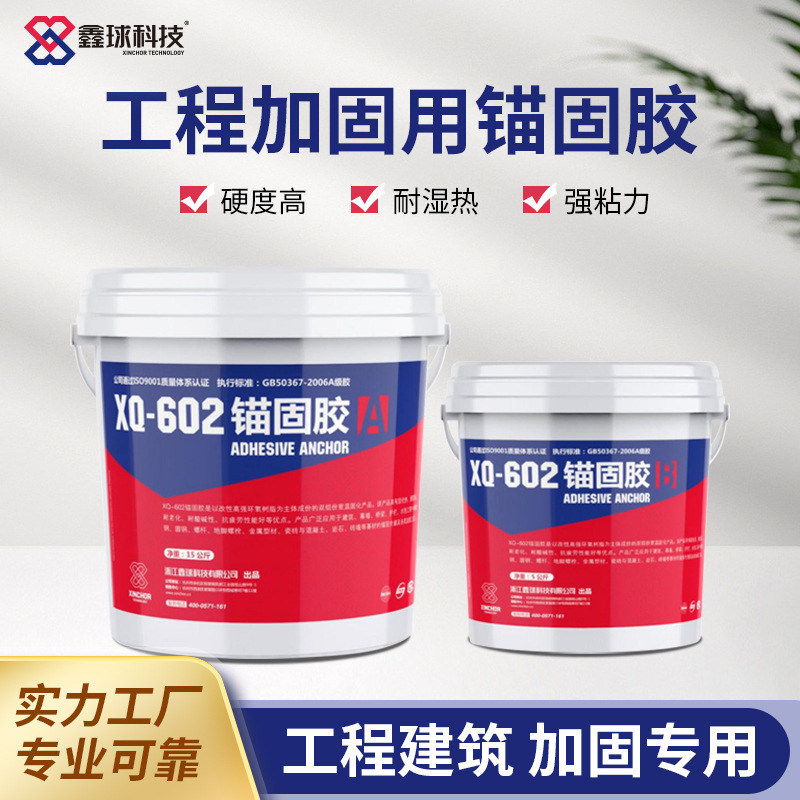
Engineers frequently ask "what is the pull-out strength of your epoxy anchor?" expecting a simple answer. The correct response is: "In what concrete grade, at what embedment depth, with what bolt diameter, and at what temperature?" An M16 epoxy anchor in C25 concrete at 10d embedment might resist 65 kN — the same anchor in C40 concrete at 15d embedment might resist 120 kN. Understanding these relationships is essential for both design and quality assurance.
As a manufacturer of epoxy anchoring systems tested according to EOTA EAD 330499 and ASTM E488, we provide both characteristic design values and field testing protocols for our products.
The Mechanics of Epoxy Anchor Pull-Out
When a tensile (pull-out) load is applied to an epoxy anchor, the load is transferred from the bolt to the concrete through three mechanisms:
1. Adhesive bond at the bolt-to-resin interface: The epoxy bonds to the bolt surface through chemical adhesion and mechanical interlock (the bolt threads provide geometry for mechanical engagement). 2. Adhesive bond at the resin-to-concrete interface: The epoxy penetrates the concrete pore structure and bonds to the drill hole wall. This is typically the weaker interface — concrete is the weakest link in the system. 3. Concrete cone breakout: At ultimate load, the concrete itself fails in a cone-shaped pattern radiating outward from the base of the anchor at approximately 35° to the surface. The cone breakout capacity depends entirely on the concrete tensile strength and the embedment depth. The failure mode determines the anchor capacity:| Failure Mode | Governing Factor | How to Increase Capacity |
|---|---|---|
| Bond failure (bolt-resin interface) | Bolt surface area × resin bond stress | Increase embedment depth or bolt diameter |
| Bond failure (resin-concrete interface) | Hole surface area × concrete bond stress | Increase embedment depth or hole diameter |
| Concrete cone breakout | Concrete tensile strength × embedment depth² | Increase embedment depth or concrete grade |
| Steel failure (bolt rupture) | Bolt cross-sectional area × steel yield stress | Use higher-grade steel or larger bolt |
| Combined cone-bond failure | Combination of cone and bond | Increase embedment depth |
For properly designed anchors (embedment depth of 10 to 15 times the bolt diameter), the governing failure mode is typically concrete cone breakout or combined cone-bond failure — meaning the concrete fails before the epoxy does. This is the desirable outcome: it means the adhesive is not the weak link.
Pull-Out Capacity Data
Characteristic Bond Stress Values
Our epoxy anchor adhesives have been tested per EOTA EAD 330499 (formerly ETAG 001) to determine characteristic bond stress values in cracked and uncracked concrete:
| Product | Concrete Grade | Uncracked Concrete τRk (MPa) | Cracked Concrete τRk,cr (MPa) | Test Standard |
|---|---|---|---|---|
| XQ-ZJ-E585 (Epoxy, 585ml) | C20/25 | 14.0 | 7.0 | EOTA EAD 330499 |
| XQ-ZJ-E585 (Epoxy, 585ml) | C30/37 | 16.0 | 8.5 | EOTA EAD 330499 |
| XQ-ZJ-E585 (Epoxy, 585ml) | C40/50 | 18.0 | 10.0 | EOTA EAD 330499 |
| XQ-ZJ-E600 (Epoxy, 600ml) | C20/25 | 12.0 | 6.0 | EOTA EAD 330499 |
| XQ-ZJ-E600 (Epoxy, 600ml) | C30/37 | 14.5 | 7.5 | EOTA EAD 330499 |
| XQ-ZJ-V390 (Vinyl Ester, 390ml) | C20/25 | 13.0 | 6.5 | EOTA EAD 330499 |
| XQ-ZJ-V390 (Vinyl Ester, 390ml) | C30/37 | 15.0 | 8.0 | EOTA EAD 330499 |
Pull-Out Capacity by Bolt Size (C25 Concrete, Uncracked, 10d Embedment)
| Bolt / Rebar Size | Hole Diameter (mm) | Embedment Depth (mm) | Characteristic Pull-Out (kN) | Design Pull-Out (kN) (γ=2.5) |
|---|---|---|---|---|
| M12 (Ø12) | 16 | 120 | 42 | 17 |
| M16 (Ø16) | 20 | 160 | 65 | 26 |
| M20 (Ø20) | 25 | 200 | 95 | 38 |
| M24 (Ø24) | 30 | 240 | 130 | 52 |
| M30 (Ø30) | 36 | 300 | 190 | 76 |
| M36 (Ø36) | 42 | 360 | 260 | 104 |
| M40 (Ø40) | 46 | 400 | 310 | 124 |
Effect of Embedment Depth on Pull-Out Capacity
For an M20 bolt in C25 uncracked concrete using XQ-ZJ-E585:
| Embedment Depth | Ratio (h/d) | Characteristic Pull-Out (kN) | Governing Failure Mode |
|---|---|---|---|
| 100 mm | 5d | 38 | Bond failure |
| 150 mm | 7.5d | 68 | Combined cone-bond |
| 200 mm | 10d | 95 | Concrete cone |
| 250 mm | 12.5d | 125 | Concrete cone |
| 300 mm | 15d | 158 | Concrete cone or steel rupture |
At 15d embedment, the M20 bolt approaches its steel yield capacity (approximately 157 kN for Grade 8.8). Beyond this point, increasing embedment depth provides no additional pull-out resistance because the steel bolt fails before the concrete or adhesive.
Pull-Out Testing Methods
Laboratory Testing (EOTA / ASTM E488)
The qualification testing protocol for epoxy anchors involves:
EOTA EAD 330499 (European qualification):- Minimum 25 individual pull-out tests per concrete grade
- Tests in both uncracked and pre-cracked concrete (0.5 mm crack width)
- Tests at 3 temperatures: low (–5°C or +5°C), standard (21°C ± 3°C), high (40°C or 80°C maximum)
- Tests with and without the "sustained load" protocol (long-term loading at 50% of characteristic strength for 3 months)
- Statistical evaluation: characteristic value = 5% fractile with 90% confidence
- Minimum 5 tests per configuration
- Tests in the target concrete grade
- Load applied at a rate of 2 to 5 kN/s until failure
- Report mean, standard deviation, and coefficient of variation
- Design values per ACI 355.4 with appropriate strength reduction factors
Field Testing (Proof Testing)
Field proof testing verifies that installed anchors meet the design requirements. This is required on many projects — especially for post-installed anchors in existing structures where concrete quality may be uncertain.
Standard field proof test procedure:- Test 3 additional anchors in the same area
- If any of the additional anchors fail, all anchors in that area are suspect — core drill to inspect adhesive fill, verify hole cleaning, and potentially re-install
Factors That Reduce Pull-Out Strength
1. Hole Cleaning (The Most Common Cause of Failure)
Inadequate hole cleaning is responsible for more epoxy anchor failures than any other factor. Drill dust left in the hole forms a weak layer between the epoxy and the concrete, reducing bond stress by 30 to 60%.
Proper cleaning procedure:2. Temperature Effects
| Temperature | Effect on Bond Stress | Effect on Cure Time |
|---|---|---|
| -5°C to 5°C | Bond stress reduced 10–15% | Cure time 3–5× longer |
| 5°C to 15°C | Bond stress reduced 5% | Cure time 2× longer |
| 15°C to 30°C | Standard performance | Standard cure time |
| 30°C to 40°C | Bond stress reduced 5% | Cure time 30% shorter |
| > 40°C | Bond stress reduced 10–20% | Working time critically shortened |
At temperatures above 40°C, the resin may gel before the bolt is fully inserted — resulting in a partially bonded anchor with severely reduced capacity. In hot climates, store cartridges in a cool location (20 to 25°C) and install anchors during the coolest part of the day.
3. Concrete Grade and Condition
Lower concrete grades have lower tensile strength, which directly reduces the concrete cone breakout capacity:
| Concrete Grade | Characteristic Cube Strength (MPa) | Tensile Strength (MPa) | Pull-Out Reduction vs. C30 |
|---|---|---|---|
| C15 | 15 | 1.1 | -35% |
| C20 | 20 | 1.5 | -20% |
| C25 | 25 | 1.8 | -10% |
| C30 | 30 | 2.0 | Baseline |
| C40 | 40 | 2.5 | +15% |
| C50 | 50 | 2.9 | +25% |
4. Edge Distance and Anchor Spacing
Anchors near edges or close to other anchors have reduced cone breakout capacity because the concrete cones overlap or extend beyond the concrete edge:
- Minimum edge distance: 1.5 × embedment depth (e.g., 240 mm for M16 at 10d embedment)
- Minimum anchor spacing: 3 × embedment depth (e.g., 480 mm for M16 at 10d embedment)
- At these minimum distances, apply reduction factors per EN 1992-4 or ACI 318 Appendix D
FAQ
Q: How do I calculate the required embedment depth for a known design load? A: Use the following simplified formula for bond-governed failure: hef = Nd × γ / (π × d × τRk), where Nd is the design tension load, γ is the safety factor (2.5 for concrete), d is the hole diameter, and τRk is the characteristic bond stress. Then check the result against the concrete cone breakout capacity. The embedment depth must satisfy both checks. Most manufacturers provide design software or tables — we provide free anchor design calculations on request. Q: Can epoxy anchors be used in seismic zones? A: Yes, but the design must use cracked concrete bond stress values (τRk,cr), which are approximately 50% of uncracked values. Our XQ-ZJ-V390 vinyl ester anchor has C1 seismic qualification per EOTA, meaning it has been tested under simulated seismic crack cycling (0.5 mm crack opening/closing for 1,000 cycles) and maintained its bond capacity. Q: What happens if I over-drill the hole diameter? A: The annular gap (space between bolt and hole wall) affects bond behavior. A 2 mm larger hole (1 mm more annular gap per side) typically reduces bond stress by 5 to 10% because the resin volume increases faster than the bond area. Our products are qualified for a specific hole diameter range (bolt diameter + 4 to 6 mm). Holes drilled outside this range may not achieve the published bond stress values. Q: How do I test epoxy anchor pull-out strength on site? A: Use a calibrated hollow-core hydraulic jack (also called a pull-out tester) rated for the expected failure load. The reaction ring must have a clear span of at least 2 × embedment depth to avoid confining the concrete cone. Apply load steadily at 2 to 5 kN per second until the target proof load (typically 1.25 × design load) is reached, then hold for 1 minute. No movement during the hold period = pass. Q: Can epoxy anchors be used in overhead (upward drilling) installations? A: Yes. Our thixotropic epoxy formulations (XQ-ZJ-E585 and XQ-ZJ-E600) are specifically designed for overhead installation — the high viscosity prevents the resin from running out of the hole before the bolt is inserted. Insert the mixer nozzle to the full depth of the hole and inject from the bottom up, ensuring the hole is completely filled before bolt insertion.Conclusion
Epoxy anchor pull-out strength is determined by the adhesive bond, the embedment depth, the hole diameter, and the concrete quality — not the adhesive alone. Proper hole cleaning, temperature management, and adherence to minimum edge distances and anchor spacing are essential for achieving the published design values. Field proof testing provides the quality assurance that the installed anchors meet the structural requirements.
View our epoxy anchor product range or request pull-out design calculations with your bolt size, concrete grade, and design loads for project-specific embedment depth recommendations.