
Why Tunnel Reinforcement Is Different from Above-Ground Structures
Tunnel reinforcement presents unique challenges that distinguish it from conventional structural repair. The environment is harsh — high humidity (often 90 to 100% RH), limited ventilation, continuous groundwater pressure, and restricted access for equipment and materials. The structural demands are equally challenging: tunnel linings must resist external earth pressure and water pressure while maintaining internal clearance dimensions that cannot be reduced by thick repair layers.
These constraints have driven the development of specialized materials and methods for tunnel reinforcement — many of which require products with characteristics quite different from standard construction materials. As a manufacturer producing chemical anchoring systems, injection resins, CFRP reinforcement materials, and polymer-modified mortars, we supply comprehensive material packages for tunnel rehabilitation projects worldwide.
Overview of Tunnel Reinforcement Methods
| Method | Primary Function | Typical Thickness | Lining Type | Ground Condition |
|---|---|---|---|---|
| Shotcrete overlay | Structural strengthening + protection | 50–150 mm | Cast-in-place or segmental | Any |
| CFRP fabric bonding | Flexural/shear strengthening | 0.5–2 mm (laminate) | Cast-in-place (curved) | Stable rock |
| Steel plate bonding | Flexural/shear strengthening | 6–12 mm plate + adhesive | Flat or gently curved | Any |
| Rock bolt anchoring | Rock stabilization, lining connection | Bolt length 2–6 m | Unlined or initial support | Fractured rock |
| Crack injection (epoxy) | Structural crack repair | Fills crack width 0.1–5 mm | Cast-in-place or segmental | Any |
| Waterproofing injection (PU) | Stop water ingress | Seals leak points | Any | Water-bearing ground |
| Cementitious grouting | Fill voids behind lining | Fills cavities behind lining | Any | Voids from washout or settlement |
| Polymer mortar repair | Surface repair + protection | 10–50 mm | Cast-in-place | Any |
1. Shotcrete Reinforcement
Shotcrete (sprayed concrete) overlay is the most common tunnel reinforcement method worldwide. A layer of high-performance sprayed concrete is applied to the existing lining to increase its load-carrying capacity and protect the original concrete from further deterioration.
Shotcrete Material Requirements for Tunnel Applications
Tunnel shotcrete must meet stricter requirements than above-ground applications:
| Property | Requirement | Reason |
|---|---|---|
| 28-day compressive strength | ≥ 40 MPa (C40 equivalent) | Structural capacity in thin sections |
| Early strength (J2 curve) | ≥ 1 MPa at 1 hour | Resist immediate rock pressure |
| Bond strength to substrate | ≥ 1.5 MPa | Prevent liner separation |
| Rebound rate | ≤ 15% (wet mix) | Minimize waste in confined space |
| Fiber reinforcement | Steel fiber 30–40 kg/m³ or synthetic macro-fiber 5–7 kg/m³ | Ductility, crack control |
| Durability class | XA2 minimum (sulfate exposure) | Groundwater often contains sulfates |
| Chloride content | ≤ 0.2% by weight of cement | Prevent reinforcement corrosion |
Application Procedure
2. CFRP Reinforcement for Tunnel Linings
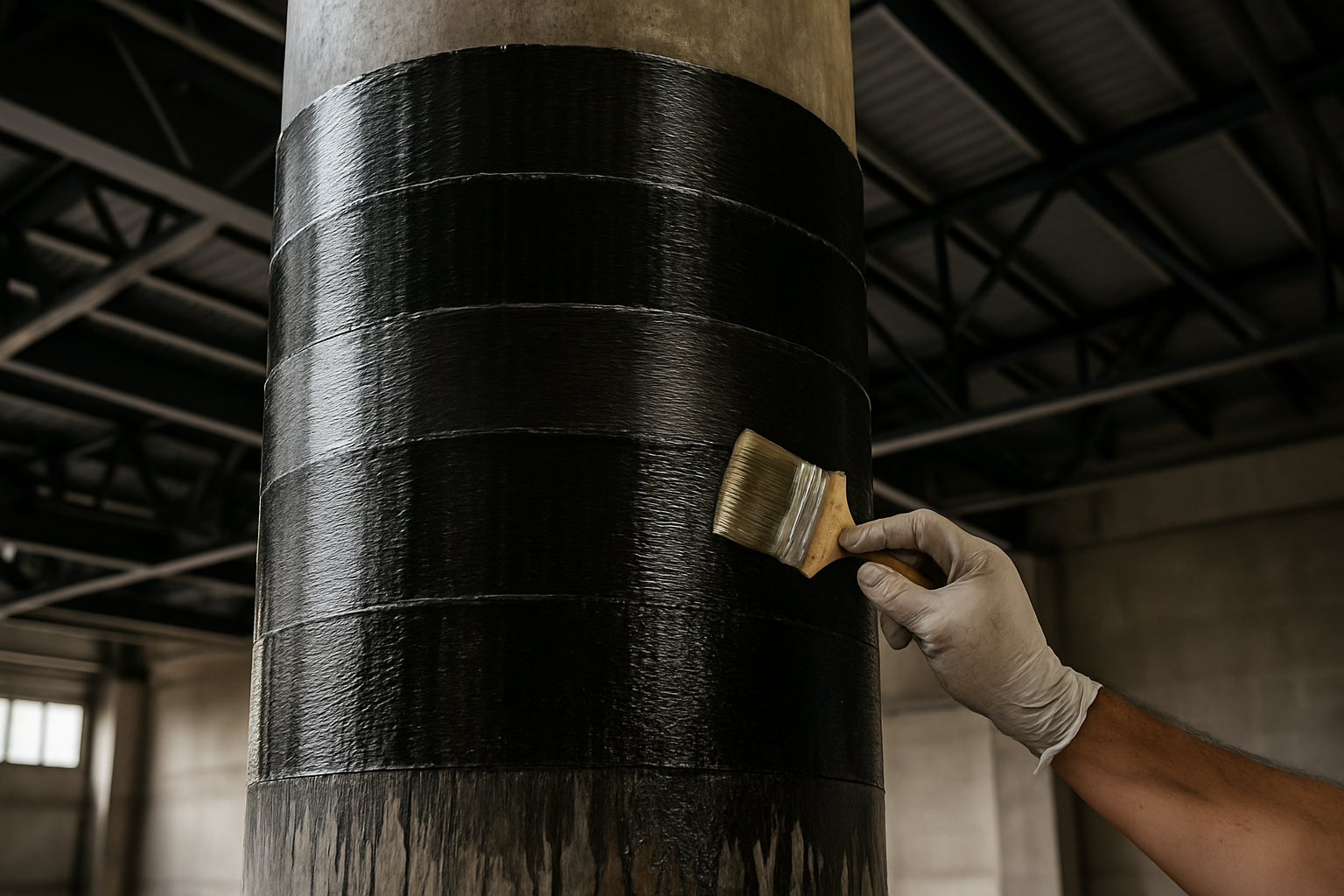
Carbon Fiber Reinforced Polymer (CFRP) fabric bonding is increasingly used for tunnel lining strengthening because it adds negligible thickness (less than 2 mm) — critical in tunnels where every millimeter of reduced clearance affects vehicle passage dimensions.
Why CFRP for Tunnels
- Minimal thickness reduction: A two-layer CFRP fabric system adds less than 2 mm to the lining surface, compared to 50 to 150 mm for shotcrete. In a road tunnel with minimum vertical clearance of 4.5 m, a 100 mm shotcrete overlay effectively reduces clearance to 4.4 m — which may require traffic restrictions. CFRP preserves the full clearance envelope.
- Corrosion immunity: Tunnel environments are aggressively corrosive (groundwater, de-icing salt spray, vehicle exhaust). CFRP does not corrode.
- Lightweight: The CFRP system adds less than 1 kg/m² to the lining, causing zero additional load on the foundation or support system.
- Fast installation: No formwork, no curing period for shotcrete, no heavy equipment.
CFRP Tunnel Application Procedure
The curved geometry of tunnel linings makes wet lay-up CFRP fabric the preferred system (rigid CFRP plates cannot conform to the lining curvature):
Tunnel-Specific Considerations for CFRP
Fire protection: Road tunnels can reach temperatures of 1,200°C in a vehicle fire. Epoxy-matrix CFRP loses structural capacity above its glass transition temperature (62 to 80°C). Fire-protective coatings or intumescent systems must be applied over the CFRP to provide 60 to 120 minutes of fire resistance, depending on the tunnel fire safety class. Moisture: Tunnel linings are almost always damp. Our moisture-tolerant primer (XQ-PR-MT) can be applied to surfaces with up to 6% moisture content (vs. 4% for standard primer). For areas with active water seepage, waterproofing injection must be performed before CFRP application.3. Rock Bolt Chemical Anchoring
Rock bolts are the primary support element for rock tunnels, transferring the weight of loosened rock blocks back into the stable rock mass. Chemical anchoring with our injection resin systems provides superior performance to mechanical expansion anchors in fractured or weak rock.
Chemical Anchor vs. Mechanical Anchor for Rock Bolts
| Factor | Chemical Anchor (Resin Cartridge) | Mechanical Expansion Anchor |
|---|---|---|
| Bond mechanism | Full-length adhesive bond | Point contact at expansion sleeve |
| Load capacity | 100% of bolt tensile capacity (full embedment) | 50–70% of bolt capacity (concentrated load transfer) |
| Performance in fractured rock | Excellent — resin fills fractures | Poor — expansion force splits weak rock |
| Performance in soft rock | Excellent — resin penetrates pore structure | Poor — expansion cannot develop adequate friction |
| Installation speed | 3–5 minutes per bolt (cure time dependent) | Instantaneous |
| Corrosion protection | Full encapsulation in resin | Exposed to groundwater at expansion zone |
| Temperature sensitivity | Limited by resin gel time | None |
- XQ-ZJ-V390 (Vinyl ester, 390ml cartridge): Gel time 5 minutes, full cure 45 minutes. C1 seismic rating. Standard choice for systematic rock bolting in tunnels where installation speed matters.
- XQ-ZJ-E585 (Epoxy, 585ml cartridge): For large-diameter bolts (Ø25 mm and above) and deep embedment. Higher bond strength but slower cure (24 hours to full capacity).
Rock Bolt Installation with Chemical Anchor
4. Crack and Leak Injection
Tunnel linings inevitably develop cracks — from construction loads, ground movement, thermal cycling, and long-term creep. Water ingress through these cracks accelerates reinforcement corrosion and causes unsightly (and damaging) calcium carbonate stalactite formation.
Injection Strategy for Tunnel Cracks
Dry structural cracks → Epoxy injection: Our low-viscosity epoxy (XQ-EI-L, 150 to 300 mPa·s) restores the lining's structural integrity. For tunnel applications, we recommend our extended-gel-time formulation (90 minutes at 15°C) to accommodate the cooler tunnel temperatures that slow injection flow. Active water leaks → Polyurethane injection: Our PU injection resin (XQ-PU) reacts with groundwater to form a flexible, waterproof foam seal. This is the standard method for stopping water ingress through segment joints, rock bolt holes, and construction joints in tunnel linings. Voids behind the lining → Cementitious grout injection: Voids between the tunnel lining and the surrounding rock can result from incomplete original grouting, washout of fines by groundwater, or settlement. Our microfine cement grout (particle size D95 < 15 μm) fills these voids under low pressure (0.5 to 2.0 bar) to restore full contact between the lining and the ground, redistributing the earth pressure uniformly.5. Polymer Modified Mortar for Surface Repair
Surface deterioration of tunnel linings — spalling, delamination, freeze-thaw damage, chemical attack — requires repair with a mortar system that can bond to damp concrete, resist the aggressive tunnel environment, and be applied overhead and on curved surfaces without slumping.
Our polymer modified repair mortar (XQ-PM) meets these requirements:
- Applies in layers of 10 to 30 mm on vertical and overhead surfaces without formwork
- Bonds to damp (SSD) concrete with ≥ 2.0 MPa pull-off strength
- Cures in the high-humidity tunnel environment (no special curing measures needed)
- Resists sulfate attack (SR class per EN 1504-3, suitable for groundwater with up to 3,000 mg/L SO₄²⁻)
Selecting the Right Tunnel Reinforcement Method
| Scenario | Recommended Method | Material System |
|---|---|---|
| Lining too thin or understrength for current loads | Shotcrete overlay (50–100 mm) or CFRP fabric | XQ-PM-SC additive or XQ-CF fabric + XQ-IR resin |
| Clearance critical — cannot lose internal dimensions | CFRP fabric bonding | XQ-CF 200g/m² or 300g/m² + XQ-IR |
| Cracked lining — structural repair needed | Epoxy crack injection | XQ-EI-L (low viscosity) |
| Water leaking through lining | PU waterproofing injection | XQ-PU |
| Voids behind lining | Cementitious grout injection | Microfine cement grout |
| Surface spalling and deterioration | Polymer modified mortar repair | XQ-PM |
| Rock bolts failing or corroding | Chemical re-anchoring | XQ-ZJ-V390 or XQ-ZJ-E585 |
| Seismic upgrade needed | CFRP fabric wrapping + shotcrete | XQ-CF + XQ-IR + shotcrete |
FAQ
Q: Can CFRP be applied in wet tunnels? A: Yes, but the moisture must be controlled. Active water leaks must be stopped with PU injection before CFRP application. For damp surfaces (no flowing water), our moisture-tolerant primer (XQ-PR-MT) allows application at up to 6% surface moisture. The impregnation resin (XQ-IR) is not moisture-tolerant — the primer must seal the surface moisture before resin application. Q: How long do chemical anchor rock bolts last in tunnels? A: Our vinyl ester and epoxy anchoring resins provide corrosion protection for the bolt's full service life (typically 100 years for permanent tunnel installations). The resin fully encapsulates the bolt, isolating it from groundwater. In aggressive environments (pH < 4 or chloride > 5,000 mg/L), specify our vinyl ester formulation (XQ-ZJ-V390) which has superior chemical resistance compared to epoxy. Q: What is the minimum temperature for tunnel repair materials? A: Most tunnel environments maintain stable temperatures of 10 to 20°C year-round, which is ideal for all our products. For portal zones in cold climates (where temperatures may drop below 5°C in winter), use our winter-grade formulations with extended working time and lower minimum application temperature (0°C for epoxy, 5°C for polymer mortar). Q: Can polymer mortar be used as the sole repair for a structurally deficient tunnel lining? A: Polymer mortar alone is not a structural strengthening method — it restores the original cross-section and protects the reinforcement but does not increase the lining's load-carrying capacity. If the lining is structurally deficient, combine polymer mortar surface repair with CFRP strengthening or shotcrete overlay for the structural upgrade. Q: How do you handle tunnel repairs while maintaining traffic? A: Lane-by-lane closures or nighttime-only work windows are standard. CFRP application is particularly suited to short closure windows because it requires no formwork, no curing time before reopening (the CFRP bonds under ambient conditions and gains strength progressively), and produces no debris. Shotcrete requires longer closures due to equipment setup, rebound cleanup, and the need to prevent fresh shotcrete from being damaged by traffic vibration.Conclusion
Tunnel reinforcement requires a multi-method approach tailored to the specific deficiency — structural understrength, water ingress, surface deterioration, or rock instability. No single product solves every tunnel problem, which is why we supply complete material systems covering injection, anchoring, CFRP strengthening, and polymer mortar repair.
Explore our tunnel reinforcement products or request a project consultation with your tunnel inspection report for material recommendations.