
The Challenge: Deteriorating Underwater Piles
Bridge piers, dock piles, and marine foundations that spend years submerged in seawater or river water face relentless deterioration. Chloride ion penetration, water flow erosion, and freeze-thaw cycling cause concrete spalling, rebar corrosion, and cross-section loss — all of which threaten the structural integrity of the entire bridge.
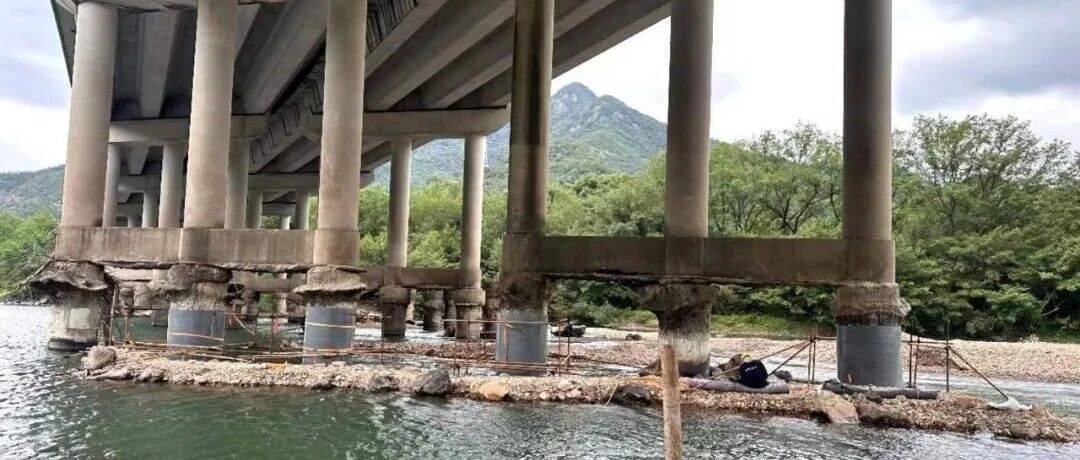
Traditional repair methods — cofferdam construction with dewatering, or steel sleeve jacketing — are expensive, time-consuming, and require traffic disruption. Steel sleeves themselves eventually corrode in marine environments, creating a recurring maintenance cycle.
FRP (Fiber Reinforced Polymer) sleeve jacketing has emerged as the preferred solution for deep-water pile repair, offering permanent corrosion resistance and underwater installation capability.What Is the FRP Sleeve System?
The FRP sleeve repair system — sometimes called the "jacket method" — consists of two core components:
Five Advantages Over Traditional Methods
1. Full Underwater Installation — No Cofferdam Required
Traditional deep-water pile repair requires cofferdam construction, dewatering pumps, heavy equipment mobilization, and often traffic closure. FRP sleeve installation is performed entirely underwater by divers — the bridge continues carrying traffic and the waterway remains navigable throughout the repair.
2. Permanent Corrosion Protection
FRP is a polymer composite material that resists acid, alkali, and salt spray — it does not corrode in seawater or contaminated water. The outer sleeve creates a physical barrier blocking chloride ion penetration, while the inner epoxy grout fills all cracks and voids. This dual-barrier system eliminates the recurring corrosion problem that plagues steel sleeve repairs.
3. Minimal Maintenance After Installation
Unlike steel sleeves that require periodic inspection and re-coating, FRP sleeve systems resist tidal wet-dry cycling, freeze-thaw damage, and water flow erosion. Once installed, the system is essentially maintenance-free for the life of the structure.
4. Shorter Construction Period
Eliminating cofferdam construction, dewatering, and formwork removal dramatically reduces the project timeline. FRP sleeves use prefabricated assembly methods, significantly improving field productivity.
5. Versatile Application
FRP sleeves adapt to multiple pile types: round, rectangular, steel, and timber piles can all be repaired. Sleeves can be custom-fabricated on-site to match specific pile diameters. The lightweight material adds negligible dead load — critical when strengthening aging foundations that cannot tolerate additional weight.
Installation Process
Applications
FRP sleeve jacketing is used for: cross-sea and cross-river bridge pier repair in splash and tidal zones; port and ferry dock pile rehabilitation; inland reservoir and lake bridge pier maintenance; preventive strengthening of aging bridge piles; and repair of concrete, steel, and timber piles.
FAQ
Q: What is the minimum water depth for FRP sleeve installation? A: FRP sleeves can be installed at virtually any depth accessible by divers. The system has been successfully used in water depths from 1 meter to over 30 meters. Q: How long does the underwater epoxy grout take to cure? A: XINCHOR underwater epoxy grout achieves initial set within 24 hours and design strength within 7 days at water temperatures above 10°C. The formulation is specifically designed to cure in submerged conditions without dispersing. Q: Can FRP sleeves handle tidal zones with alternating wet-dry conditions? A: Yes. FRP composites excel in tidal zones precisely because they resist the wet-dry cycling that accelerates corrosion in steel. The material maintains its mechanical properties through unlimited wet-dry cycles.---
Related Resources
- Underwater Concrete Repair: Methods, Materials & Step-by-Step Guide — Comprehensive guide to underwater repair techniques including anti-washout grout and epoxy injection.
- Fiber Reinforced Polymer (FRP) Guide — Complete reference on FRP material properties, types, and structural applications.
- Epoxy Grout for Machinery Foundations — Underwater epoxy grout formulations and application methods.
- FRP Jacketing Products — XINCHOR glass fiber sleeve, underwater epoxy grout, and high-strength polymer mortar for pile repair.