
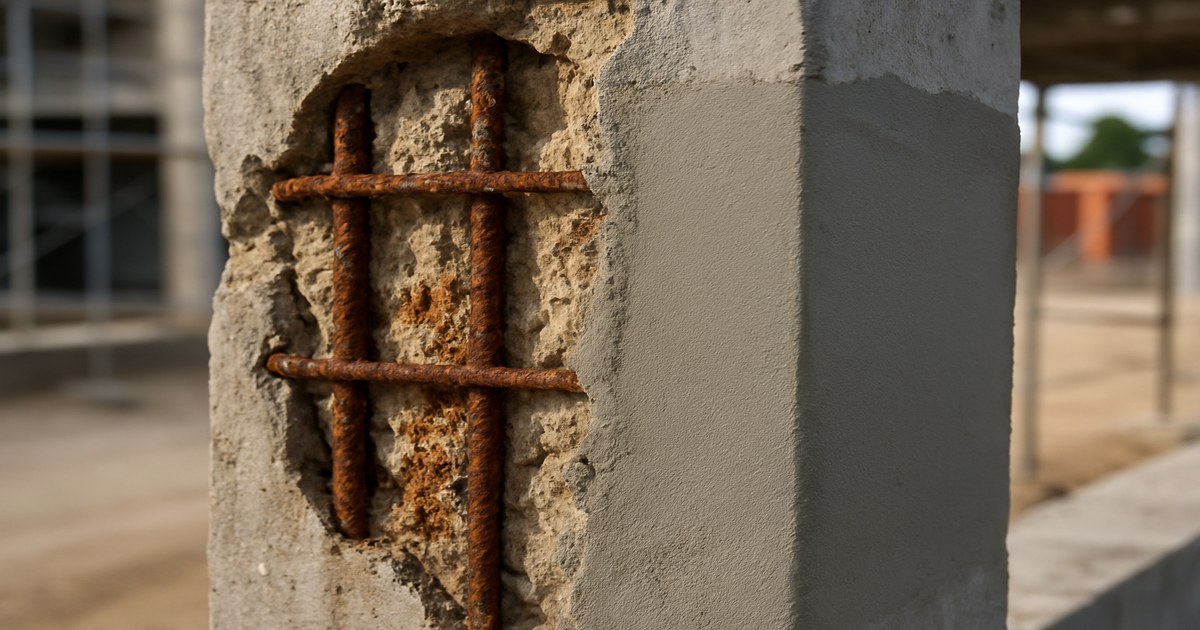
Why Steel in Concrete Corrodes at All
Fresh concrete has a pore water pH of about 12.5 to 13.5. At that alkalinity, a passive iron oxide film forms on the reinforcement and keeps corrosion rates below roughly 0.1 µm per year — effectively zero. Reinforced concrete works because concrete chemically protects the steel, not just physically covers it.
That passive film is destroyed in exactly two ways:
Carbonation. Atmospheric CO₂ diffuses into the concrete and reacts with calcium hydroxide, dropping the pH to around 8–9. Once the carbonation front reaches the reinforcement, passivity is lost across the whole exposed length. Carbonation depth advances roughly with the square root of time: d = k√t, where k is typically 2–5 mm/year^0.5 for good quality C35 concrete and 8–15 for porous or poorly cured concrete. This is the dominant mechanism on inland buildings, car parks, and older residential structures. Chloride attack. Chloride ions from de-icing salt, seawater, or contaminated aggregate penetrate to the steel and break down the passive film locally, even at high pH. The commonly cited critical threshold is 0.4% chloride by weight of cement (about 0.05–0.07% by weight of concrete), though the real value depends on moisture and pH. This is a *pitting* mechanism — deep, localised loss rather than uniform rust. It dominates on marine structures, bridges, and coastal buildings.The consequence is the same either way. Rust occupies 2 to 6 times the volume of the parent steel, generating expansive pressures of 15–40 MPa against concrete whose tensile strength is 2–4 MPa. The cover cracks, delaminates, and spalls.
> Why this matters commercially: a 10 mm diameter bar that has lost 20% of its cross-section has lost 20% of its tensile capacity. In a lightly reinforced slab that can be the difference between adequate and non-compliant. Corrosion is a structural problem long before it is an aesthetic one.
Step 1: Diagnose Before You Specify
We supply repair mortars to contractors across 40 countries, and the single strongest predictor of a repair failing within three years is that nobody ran a condition survey. Four tests, all cheap:
| Test | Standard | What it tells you | Typical cost |
|---|---|---|---|
| Delamination survey (hammer / chain drag) | ASTM D4580 | Extent of hollow, debonded cover | Labour only |
| Half-cell potential mapping | ASTM C876 | Probability of active corrosion | USD 2–5 /m² |
| Carbonation depth (phenolphthalein on fresh core) | EN 14630 | Whether carbonation reached the steel | USD 15–30 /test |
| Chloride content by depth profile | ASTM C1152 / EN 14629 | Chloride at rebar level vs. threshold | USD 40–80 /profile |
| Cover depth survey | BS 1881-204 | Where cover is deficient | USD 1–3 /m² |
| Potential | Corrosion probability |
|---|---|
| More positive than −200 mV | Less than 10% — passive |
| −200 to −350 mV | Uncertain |
| More negative than −350 mV | Greater than 90% — actively corroding |
| More negative than −500 mV | Severe, often with visible section loss |
Potential *gradients* matter more than absolute values. A 150 mV swing over half a metre marks an anode, and that is where you will find the damage even if the surface still looks intact.
Step 2: Choose the Right EN 1504 Repair Principle
EN 1504 is the European framework for concrete repair and it is the language most international consultants specify in. Part 9 defines 11 principles; six apply to corrosion work:| Principle | Name | Method in practice | Use when |
|---|---|---|---|
| P3 | Concrete restoration | Break out and reinstate with repair mortar (EN 1504-3) | Damage is localised and cause is removable |
| P7 | Preserving/restoring passivity | Reinstate alkaline cover; apply rebar coating (EN 1504-7) | Carbonation-driven damage |
| P2 | Moisture control | Surface protection systems, coatings (EN 1504-2) | Ongoing ingress |
| P8 | Increasing resistivity | Hydrophobic impregnation | Wet/dry cycling |
| P9 | Cathodic control | Sacrificial anodes | Chloride contamination remains |
| P10 | Cathodic protection | Impressed current CP | Widespread chloride, high-value asset |
| P4 | Structural strengthening | CFRP plate or fabric bonding | Section loss has reduced capacity |
The mistake almost everyone makes is applying P3 alone to a chloride-contaminated structure. Repair mortar is alkaline and highly resistive; the steel inside it repassivates while the steel in the surrounding chloride-laden concrete stays active. You have just built a macro-cell with the patch as cathode. The result is the "halo effect" — a new ring of spalling around a perfectly sound patch, typically appearing 18 to 36 months later. If chloride at rebar level exceeds 0.4% by weight of cement, P3 must be combined with P9 or P10.
Step 3: Breakout Geometry — The Part That Decides Everything
Get this wrong and no mortar on earth will save the repair.
Step 4: Material Selection
| Situation | Product | Key specification |
|---|---|---|
| General patch repair, 10–80 mm deep, vertical/overhead | Structural Repair Mortar XQ-SJ-SR | ≥ 60 MPa at 28 d, bond ≥ 2.5 MPa, up to 80 mm in one layer, no formwork |
| Thin patching and levelling, 5–30 mm | Polymer Modified Repair Mortar XQ-SJ-P | ≥ 45 MPa at 28 d, bond ≥ 2 MPa, just add water |
| Aggressive chemical or marine splash zone | Anti-Corrosion Polymer Mortar XQ-SJ-AC | Acid resistant pH 2–14, ≥ 65 MPa, impermeable overlay |
| High-load bearing areas, industrial floors | Epoxy Repair Mortar XQ-SJ-E | ≥ 75 MPa at 7 d, bond ≥ 3 MPa, chemical resistant |
| Traffic-bearing repairs with a short closure window | Rapid-Set Repair Mortar XQ-SJ-R | 30 MPa in 2 h, foot traffic 2 h, vehicles 4 h |
| Fine cracks feeding chloride to the steel | Low-viscosity injection resin | 150–300 mPa·s, seals cracks 0.1–1.0 mm |
| Section loss requiring capacity restoration | Carbon fibre fabric or CFRP plate | 3,400 MPa tensile, 230 GPa modulus |
Matching the mortar to the substrate
A repair mortar that is far stiffer than the parent concrete attracts load it was never designed to carry and debonds. As a rule of thumb, keep the repair material's elastic modulus within roughly ±25% of the substrate concrete, and its drying shrinkage below 600 microstrain at 28 days (EN 12617-4). A 75 MPa epoxy mortar on a tired C25 slab is a specification error, not an upgrade — reserve epoxy mortars for genuinely high-stress or chemically attacked areas and use polymer-modified cementitious mortar for the bulk of patch repair. Our concrete repair mortar selection guide goes through this trade-off in detail.
Step 5: When Repair Is Not Enough — Strengthening
If section loss has taken the member below its required capacity, mortar restores geometry but not strength. Two options:
CFRP fabric wrapping for columns and confinement. A 300 g/m² unidirectional carbon fabric bonded with epoxy adds roughly 500–800 kN of tensile capacity per layer per metre of width, adds under 1 mm of thickness, and applies no additional dead load. It also confines the concrete, which raises the effective compressive strength of a damaged column. See concrete column strengthening methods. CFRP plate bonding for beams and slabs in flexure. A 100 × 1.4 mm plate at 2,400 MPa design tensile strength is equivalent in axial capacity to roughly 340 mm² of grade 500 rebar, bonded with a thixotropic plate bonding adhesive.One critical sequencing rule: never bond CFRP over concrete that is still actively corroding. The carbon fibre is cathodic to steel; if moisture and chloride reach both, you accelerate the corrosion you are trying to compensate for, and it happens invisibly under an impermeable laminate. Complete the corrosion mitigation first, verify with half-cell readings, then strengthen.
Costs, MOQ and Lead Time
| Material | Typical FOB Ningbo price | MOQ | Lead time |
|---|---|---|---|
| Polymer modified repair mortar (25 kg bag) | USD 0.30–0.55 /kg | 1,000 kg | 10–15 days |
| Structural repair mortar (25 kg bag) | USD 0.45–0.80 /kg | 1,000 kg | 10–15 days |
| Anti-corrosion polymer mortar (25 kg set) | USD 1.60–2.80 /kg | 500 kg | 12–18 days |
| Epoxy repair mortar (25 kg set) | USD 2.80–4.50 /kg | 500 kg | 12–18 days |
| Low-viscosity injection resin | USD 6.50–11.00 /kg | 200 kg | 12–18 days |
| 300 g/m² unidirectional carbon fabric | USD 9.00–15.00 /m² | 500 m² | 15–20 days |
Coverage for planning: 25 kg of cementitious repair mortar yields roughly 12–13 litres of placed material, so a 30 mm deep patch covers about 0.42 m² per bag. Add 10–15% waste on vertical and overhead work.
All products ship with ISO 9001 certification and batch test reports; SGS and third-party testing to EN 1504-3 class R3/R4 is available on request. Free 5 kg samples are supplied for qualified projects.
Working on a corrosion repair tender? Send us your condition survey — chloride profile, carbonation depth, and half-cell map — and our technical team will return a material specification aligned to the EN 1504 principles, with quantities and FOB pricing, within one working day. Request a specification →Frequently Asked Questions
Q: How do I know whether my concrete has chloride or carbonation damage? A: Take a core, spray the fresh fracture face with phenolphthalein — the carbonated zone stays colourless while sound alkaline concrete turns purple. Measure the depth and compare it to the cover depth. Separately, run a chloride profile at 10, 25, and 50 mm depths. If chloride at rebar level is above 0.4% by weight of cement, chloride is your mechanism regardless of what the carbonation test shows. Q: Why did new spalling appear next to my repair patch after two years? A: That is the incipient anode or "halo" effect. The patch repassivated the steel inside it, turning it into a cathode, while the chloride-contaminated concrete around it stayed anodic. Corrosion current concentrated at the patch boundary. The fix is to install sacrificial anodes at the patch perimeter — EN 1504 Principle 9 — as part of the original repair, not to keep patching. Q: Can I just apply an anti-carbonation coating instead of breaking out? A: Only if the carbonation front has not yet reached the steel and there is no delamination. A coating (EN 1504-2) slows further CO₂ ingress but does nothing about corrosion already underway. If the concrete sounds hollow, coating over it just hides the problem. Q: How much rebar section loss can I accept before I have to add steel? A: Most codes and repair specifications trigger supplementary reinforcement at 20% loss of original bar cross-sectional area. Below that, clean, prime, and reinstate cover. Above it, either lap in a new bar with a minimum 40-diameter lap or add external CFRP sized to make up the deficit, which is often faster on an occupied structure. Q: What is the difference between EN 1504-3 class R3 and R4 mortar? A: They are structural repair mortar classes. R3 requires ≥ 25 MPa compressive strength and ≥ 1.5 MPa bond; R4 requires ≥ 45 MPa and ≥ 2.0 MPa bond, plus tighter limits on shrinkage and elastic modulus. R4 is specified for load-bearing structural repair; R3 is acceptable for non-structural reinstatement of cover. Q: Do I need to coat the cleaned reinforcement? A: For carbonation repair with a full-depth alkaline reinstatement, a rebar coating is optional — the mortar itself repassivates the steel. For chloride environments, patch repairs with limited breakout, or where cover will remain below 25 mm, apply a cementitious or epoxy rebar primer to EN 1504-7 within 3 hours of blasting. Q: How long does a properly executed corrosion repair last? A: When the mechanism has been correctly diagnosed and addressed, a P3 + P7 carbonation repair with a surface protection system typically gives 20–25 years before the next intervention. A chloride repair combined with sacrificial anodes gives 10–20 years depending on anode sizing. A patch-only repair on chloride-contaminated concrete commonly fails in 2–3 years — which is why the survey is worth more than the mortar. Q: Can repair mortar be applied overhead? A: Yes. Our structural and polymer-modified repair mortars are thixotropic and will hold on soffits at up to 40 mm per layer without formwork. For deeper overhead reinstatement, either build up in successive layers with a scratch key between them, or form and pour a flowable micro-concrete instead.Related Guides
- Concrete Repair Mortar Types and Selection Guide
- Concrete Patch Repair Materials and Methods
- Concrete Column Strengthening Methods
- Concrete Crack Injection: Methods and Materials
- Polymer Modified Cementitious Mortar Properties
- Parking Structure Repair with Carbon Fiber Strengthening
- Browse our polymer mortar range →
*XINCHOR manufactures polymer repair mortars, corrosion-resistant overlays, injection resins, and CFRP strengthening systems used on bridge, marine, and industrial repair projects in over 40 countries. Contact XINCHOR for a project-specific specification — WhatsApp: +86 133 3618 3725 | Email: [email protected]*