
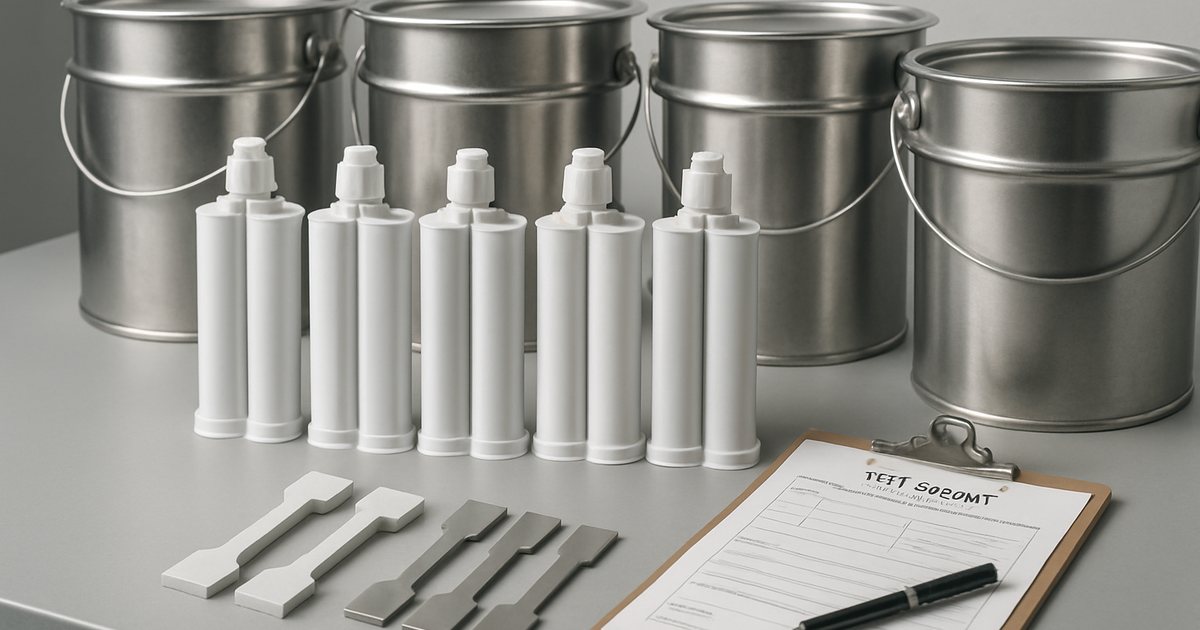
We have been manufacturing two-component structural epoxies — steel bonding adhesives, CFRP impregnation and plate bonding resins, anchor adhesives, and segment splicing adhesives — since 2005, and we have been on both sides of this conversation: audited by European and Middle Eastern buyers, and sourcing raw resin ourselves. This is the qualification process we would run if we were the buyer.
Why Structural Adhesive Sourcing Goes Wrong
Structural adhesive is an unusual purchase. The failure mode is delayed, hidden, and expensive. A bad batch of anchor adhesive does not fail on the day it is installed — it fails eighteen months later under sustained load, after the contractor has demobilised and the ceiling has been closed up.
Three patterns account for most of the trouble we see when a customer switches to us after a bad experience:
Trading companies presenting as factories. Roughly half the "manufacturers" listed on B2B marketplaces for structural adhesive are trading offices. They can quote and ship, but when your engineer asks why the pot life at 35 °C is different from the data sheet, there is nobody who knows. Technical support is not a nice-to-have on structural bonding; it is the product. Data sheets copied from a competitor. A surprising number of TDS documents circulating in the industry are lifted from major-brand literature with the logo changed. The tell is a data sheet with excellent numbers and no test method beside them. A real figure reads "lap-shear strength 22 MPa, ISO 4587, steel/steel, 7 d at 23 °C" — not "shear strength: strong." Silent reformulation. The first container matches the sample. The fifth is 20% cheaper to make, because the filler loading went up and the reactive diluent changed. This is why you specify a batch COA and retain a sample from every shipment.The Five-Document Qualification Pack
Ask for these in your first technical email. The response time and completeness tell you almost everything.
| Document | What it proves | Red flag |
|---|---|---|
| ISO 9001 certificate | A quality system exists | Scope names "trading" or a different product; certifier not IAF-accredited |
| ETA (EAD 330499) or ICC-ES ESR | Independent type testing of an anchoring product | "CE marked" with no ETA number; a certificate for a different SKU |
| Batch certificate of analysis | This specific lot was tested | Identical numbers on every COA — real batches vary |
| Safety data sheet, 16 sections | Composition and transport class are known | Missing UN numbers, missing hazard statements, wrong language |
| ISO 14001 / factory registration | Real premises, real capacity | No business licence number you can verify |
The single most useful of these is the batch COA. Ask for COAs from three different production dates. If the tensile strength reads 32.0 MPa on all three, they are not testing — they are typing. Genuine production data scatters: 31.4, 33.1, 32.6.
For anchoring adhesives specifically, a European Technical Assessment issued against EAD 330499 (bonded fasteners for use in concrete) is the strongest signal available, because it involves sustained-load, seismic, and freeze-thaw testing that a factory cannot fake. Ask for the ETA number and look it up yourself in the issuing body's register. We cover what those tests actually measure in our epoxy anchor pull-out strength testing guide.
Technical Specifications That Should Appear on Every Data Sheet
If a supplier's TDS is missing more than two of these, it is not a technical document.
| Property | Test method | Typical structural epoxy range | Why buyers care |
|---|---|---|---|
| Tensile strength | ISO 527 / ASTM D638 | 30–50 MPa | Governs the resin's own capacity |
| Lap-shear, steel/steel | ISO 4587 / ASTM D1002 | 15–28 MPa | The number that matters for bonded plates |
| Compressive strength | ISO 604 / ASTM D695 | 70–95 MPa | Governs anchor and grout behaviour |
| Bond to concrete (pull-off) | EN 1542 / ASTM D7234 | ≥ 2.5 MPa, concrete failure | Anything less means a weak product or weak prep |
| Glass transition temp. (Tg) | ISO 11357 DSC / ASTM E1640 | 45–75 °C standard, 80–120 °C high-temp | The real service temperature ceiling |
| Pot life at 25 °C | ISO 9396 | 25–90 min | Determines batch size on site |
| Mixed density | ISO 2811 | 1.35–1.75 g/cm³ | Converts price per kg to price per litre applied |
| Shrinkage on cure | ASTM D2566 | < 0.1% | Critical for anchors and grouts |
| Creep under sustained load | EAD 330499 / ASTM D2294 | Report required | The mechanism behind most anchor failures |
| Shelf life | — | 12–24 months, 5–30 °C | Governs your stock strategy |
> Need a spec comparison against your current supplier's data sheet? Send us the TDS and we will return a line-by-line comparison against the equivalent XINCHOR grade. Contact XINCHOR.
Manufacturer vs Trading Company vs Distributor
| Direct manufacturer | Trading company | Regional distributor | |
|---|---|---|---|
| Typical price index | 1.0× | 1.15–1.4× | 1.6–2.5× |
| Custom formulation | Yes | No | Rarely |
| Private label / OEM | Yes | Sometimes (they subcontract) | No |
| Technical response time | Hours | Days, if at all | Hours |
| MOQ | 200–1,000 kg | Low — they consolidate | Single cartridge |
| Lead time | 15–25 days + shipping | 20–35 days | Ex-stock |
| Batch traceability | Full | Partial | Depends on origin |
| Best for | Volume, OEM, project supply | One-off small mixed orders | Urgent site top-ups |
There is no universally right answer here. If you need 40 cartridges next Tuesday, a distributor is correct and the premium is worth it. If you are supplying a bridge strengthening contract over eighteen months, buying direct saves 30–50% and — more importantly — gives you a formulator who will answer questions about your specific substrate.
How to tell a factory from a trading office in one email: ask for a photograph of the reactor and the batch number system, and ask what the standard reactor charge size is. A manufacturer answers immediately with a number like "2,000 L reactor, standard charge 1,600 kg." A trading company changes the subject to price.Pricing Benchmarks: What Structural Adhesive Should Cost
Indicative FOB Ningbo pricing from our factory, current for 2026. Use these as a sanity check on quotes, not as a firm offer — filler loading, packaging, and certification requirements all move the number.
| Product type | Indicative FOB price | MOQ | Lead time |
|---|---|---|---|
| Epoxy steel bonding adhesive (bulk, A+B pails) | USD 4.20–7.50 /kg | 500 kg | 15–20 days |
| CFRP impregnation resin | USD 5.00–8.50 /kg | 500 kg | 15–20 days |
| CFRP plate bonding adhesive | USD 4.80–8.00 /kg | 500 kg | 15–20 days |
| Epoxy anchor adhesive, 390 ml cartridge | USD 3.60–6.20 /pc | 1,000 pcs | 20–25 days |
| Epoxy anchor adhesive, 585/600 ml cartridge | USD 5.20–8.90 /pc | 1,000 pcs | 20–25 days |
| Vinyl ester anchor adhesive, 390 ml | USD 3.00–5.10 /pc | 1,000 pcs | 20–25 days |
| High-temperature epoxy (Tg ≥ 90 °C) | USD 8.50–14.00 /kg | 300 kg | 20–30 days |
| Segment splicing adhesive | USD 4.00–6.80 /kg | 500 kg | 15–20 days |
Three things that legitimately move price, and one that should worry you:
- Filler loading. Silica-filled adhesives cost less per kilogram than unfilled ones but are also denser, so compare on price per litre of applied volume, not per kilogram. A 1.75 g/cm³ product at USD 5.00/kg costs more per litre than a 1.40 g/cm³ product at USD 5.50/kg.
- Hardener chemistry. Amine hardeners are cheap; cycloaliphatic and modified amidoamine systems that tolerate wet or cold substrates cost more, and should.
- Certification. An ETA-approved anchoring SKU typically carries a 15–30% premium over an uncertified equivalent. That is the cost of the testing programme amortised, and it is legitimate.
- A quote 40% below the band above almost always means one of: solvent extension, heavy calcium carbonate loading, or a hardener substitution. Ask for the mixed density and the Tg. Those two numbers expose most of it.
Shipping, Documentation and the DG Question
This is where first-time importers lose two weeks.
Most two-component structural epoxies ship as dangerous goods. The resin side is frequently UN 3082 (environmentally hazardous substance, liquid, Class 9) and the amine hardener side is commonly UN 2735 (polyamines, liquid, corrosive, Class 8) or UN 2922. Consequences:
- Sea freight needs a dangerous goods declaration and the packing must match the UN packaging specification marked on the drum. Budget 3–7 extra days.
- Air freight is often impractical for Class 8 amines in commercial quantities. Plan around it.
- Some products are non-hazardous — heavily filled paste adhesives and most cementitious products often are. Ask early; it changes your freight cost materially.
- Your customs broker will need the HS code. Epoxy-based adhesives generally fall under 3506.91 or 3907.30 depending on presentation; confirm with your broker before booking.
OEM and Private Label: What Is Actually Possible
Distributors and regional brands routinely buy structural adhesive under their own label. What a real manufacturer can do:
- Private label packaging — your artwork on cartridges, pails, and cartons. Typically adds 7–10 days and needs a first order of around 1,000 cartridges or 500 kg per SKU for a dedicated print run.
- Formulation adjustment — pot life extended for hot climates, thixotropy increased for overhead work, colour changed for visual verification. These are hardener and additive changes, generally achievable in 2–4 weeks of lab work plus a sample round.
- Your own TDS and SDS issued under your brand, with the test data behind it.
- Third-party test witnessing — a manufacturer should be willing to have SGS, TÜV, or Bureau Veritas witness production or pull samples from your container.
A Practical Qualification Sequence
The same logic applies whichever product line you are buying — we describe the anchoring-specific version in our epoxy anchor manufacturer sourcing guide, and the CFRP-specific version in top carbon fiber manufacturers in China.
Related Guides
- Structural adhesive selection guide for construction
- Two-part epoxy adhesive: chemistry, mixing and applications
- Structural adhesive temperature resistance and Tg
- Structural epoxy adhesive for steel bonding
- Epoxy anchor manufacturer: China factory-direct sourcing
- Metal-to-concrete adhesive bonding guide
- Browse the structural adhesive range and anchor adhesive range
Frequently Asked Questions
How do I verify a Chinese structural adhesive manufacturer is a real factory?
Three checks, all free. Ask for the business licence number and look it up in China's National Enterprise Credit Information Publicity System. Ask for the reactor volume and standard batch charge — a trading company cannot answer this naturally. Then request a live video walk of the production line and the QC lab, unscripted, showing the tensile tester and the DSC or oven. Any real manufacturer will do this within a couple of days.
What is a reasonable MOQ for structural adhesive from a factory?
For bulk epoxy in A+B pails, 300–500 kg per grade is normal and 1,000 kg gets better pricing. For cartridge products, 1,000 pieces per SKU is standard because cartridge filling is a set-up-heavy operation. Below those quantities you are usually better off with a distributor — the freight and documentation cost on a small direct order will erase the unit price saving.
Should I pay for samples?
Yes, always. A free sample is a marketing sample and there is no reason to believe it came from production. Paying — typically USD 100–300 including express freight — lets you demand a batch number and the matching certificate of analysis, which is the thing you are actually buying. Any supplier who refuses to give you a batch number for a paid sample has told you what you need to know.
What certifications actually matter for structural adhesives?
For anchoring into concrete, a European Technical Assessment against EAD 330499 or an ICC-ES evaluation report is the meaningful one, because it involves sustained-load and seismic testing. For general structural bonding, ISO 9001 with the correct scope plus credible batch COAs matter more than any single mark. Be sceptical of "CE certified" claims without an ETA or DoP number attached — CE marking for construction products requires a specific harmonised route, and a bare logo proves nothing.
How long does structural epoxy adhesive keep?
Twelve to twenty-four months in unopened original packaging stored between 5 and 30 °C, away from direct sun. Amine hardeners are the limiting component; they absorb carbon dioxide and moisture, forming carbamate that clouds the liquid and reduces cure quality. If a hardener has crystallised in cold storage, gentle warming to 40 °C usually restores it — but if it has skinned or gone cloudy from moisture, discard it. Rotate stock strictly first-in-first-out.
Is a two-component epoxy always better than a one-component adhesive?
For structural load transfer, yes in practice. One-component systems either need heat cure (impractical on site) or rely on moisture cure, which limits achievable modulus and thickness. Every genuinely structural construction adhesive — anchor, plate bonding, steel bonding, segment splicing — is two-component. Where one-component products earn their place is sealing, non-structural bonding, and gap filling.
Can a supplier match my existing product so I can switch without re-specifying?
Usually, within limits. Send the incumbent's TDS and SDS and, ideally, a retained sample. A competent formulator can generally match mechanical properties, pot life, and rheology within a few weeks. What cannot be transferred is a third-party approval — if your specification names a particular ETA number, changing product means re-approval by the engineer regardless of how closely the properties match. Raise that with your specifier before you start.
What lead time should I plan for a full container?
For a 20-foot container of mixed bulk epoxy grades from our factory, plan 20–25 days from confirmed order and deposit to loading at Ningbo, plus dangerous goods documentation and your ocean transit. Cartridge products run 20–25 days. Private-label artwork adds about 7–10 days on the first order only. Custom formulation work adds 2–4 weeks ahead of production. Quote your engineer a realistic date that includes DG paperwork — that is where programmes usually slip.
---
*XINCHOR manufactures two-component structural epoxies, anchor adhesives, CFRP impregnation and plate bonding resins, injection resins, grouts, and repair mortars, supplying contractors and distributors in over 40 countries. We ship OEM and private label, and every batch carries a certificate of analysis. Contact XINCHOR for a technical comparison against your current supplier — WhatsApp: +86 133 3618 3725 | Email: [email protected]*