
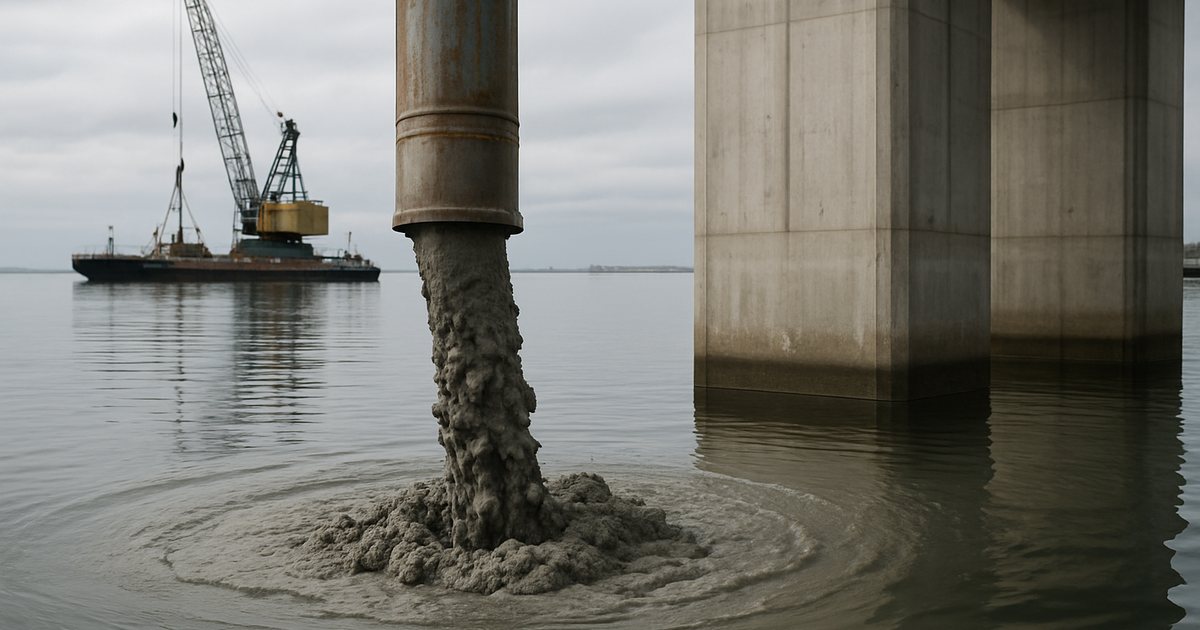
We manufacture underwater grouts, non-dispersible mortars, and water-tolerant epoxy systems that ship to marine contractors in more than 40 countries. This guide covers what we get asked on almost every enquiry: which material for which depth, how much washout is acceptable, what the pour actually costs, and where crews get it wrong.
If your problem is an *existing* damaged pier, jacket, or slab rather than a new pour, read our companion article on underwater concrete repair methods and materials — this page is about placing cementitious and polymer material underwater.
Why Concrete Behaves Differently Below the Waterline
Three failure mechanisms account for nearly every underwater placement defect we see in post-pour core reports.
1. Cement washout. Free-falling concrete drags water through itself. The finest fraction — cement, silica fume, limestone powder — is carried away as a grey plume. A 20% paste loss will typically cost you 30–50% of design compressive strength and leaves the coarse aggregate as a porous, honeycombed skeleton. 2. Laitance and cold joints. Cement fines that wash out do not disappear. They settle back onto the top of the placed concrete as a weak, soupy laitance layer. Pour the next lift onto it and you have built a horizontal plane of near-zero shear capacity into the structure. 3. Trapped water at the bond line. Even where washout is controlled, a film of water on the substrate stops most standard epoxies from wetting the surface. This is why "underwater epoxy" is a distinct chemistry and not just a normal adhesive used in a wet place.Anti-washout admixtures address the first mechanism by making the mix water viscous rather than by adding more cement. Cellulose-ether types thicken the aqueous phase directly; acrylic and polyacrylamide types work by polymer bridging between cement particles. Both are covered in ACI PRC-546.2-20, *Guide to Underwater Repair of Concrete*, which remains the reference document contractors are usually asked to comply with.
Mix Design Targets for Underwater Concrete
These are the proportioning windows we design our underwater grout and mortar formulations against, and the ones we recommend when a contractor is batching structural concrete on site.
| Parameter | Structural underwater concrete | Underwater grout / mortar | Why it matters |
|---|---|---|---|
| Water–cementitious ratio | 0.35–0.45 | 0.30–0.38 | Below 0.35 the mix will not flow through a tremie without high-range water reducer |
| Total fines (cement + SCM + filler) | 360–500 kg/m³ | 550–750 kg/m³ | Fines carry the cohesion; lean mixes wash out first |
| Water : fines by volume | 0.85–1.00 | 0.80–0.95 | The single best predictor of washout resistance |
| Sand : total aggregate | 45–50% | 100% (no coarse) | Sand-rich mixes self-consolidate without vibration |
| Max aggregate size | 10–19 mm structural; 19–25 mm mass | 0.6–2.5 mm | Large aggregate bridges in the tremie and segregates |
| Silica fume | 0–6% of binder | 3–8% | Adds cohesion and chloride resistance in seawater |
| Limestone powder | 0–20% of cement | 10–25% | Cheap fines that raise paste volume without heat |
| Slump / slump flow | 175–200 mm slump | 550–650 mm flow | Below 175 mm the tremie chokes; above 220 mm it segregates |
| AWA dosage | 0.2–0.5% (cellulose) by cement mass | pre-blended | Overdosing delays set by 12–24 hours |
| Washout loss (CRD-C 61) | ≤ 10% | ≤ 6% | Untreated control mixes lose 10–20% |
Two numbers here are worth memorising. Water-to-fines by volume of 0.85–1.00 is the target that keeps a mix cohesive; if you only check one thing on a trial batch, check that. And washout loss ≤ 10% is the acceptance criterion most marine specifications write in — the standard test drops a 2 kg sample basket through a 1.7 m water column three times and weighs what is left.
The Three Placement Methods, Compared
| Method | Practical depth | Typical use | Strength retained vs. dry pour | Diver support | Relative material cost |
|---|---|---|---|---|---|
| Tremie pipe (200–300 mm dia.) | 3–60 m | Bored pile plugs, cofferdam seals, large mass pours | 90–100% | Optional | 1.0× (baseline) |
| Concrete pump with sealed hose | 2–30 m | Pile caps, congested reinforcement, confined access | 88–98% | Usually yes | 1.05–1.2× |
| AWA non-dispersible concrete, free-placed or bagged | 0–15 m | Scour repair, void filling, pier encasement, small pours | 80–92% | Yes | 1.3–1.8× |
| Formed-and-pumped grout / preplaced aggregate | 0–40 m | Pile jackets, tight voids, precision grouting | 92–100% | Yes | 1.6–2.5× |
| Water-curable epoxy grout / mortar | 0–40 m | Anchor pockets, narrow voids, bearing seats, bolt setting | Exceeds parent concrete | Yes | 8–20× |
> Not sure which route fits your geometry and depth? Send us the section drawing and water depth and our engineering team will size the pour and the material. Contact XINCHOR.
Tremie Placement: The Rules That Actually Get Broken
Underwater Grouting and Epoxy Systems
Once the volume drops below roughly 2 m³, or the void is narrow, grouting takes over from concreting.
Cementitious underwater grout is a pre-blended, factory-controlled system with AWA, plasticiser, and a shrinkage-compensating expansive agent already in the bag. It is pumped through a hose to the bottom of the void and rises, displacing water upward through a vent. Our underwater grout XQ-GJ-UW is formulated to this pattern: 28-day compressive strength ≥ 60 MPa, washout loss ≤ 5%, flow cone efflux 18–25 s, and no bleed. It works for pile jackets, scour voids, sheet-pile toe repairs, and bedding under precast units. Water-curable epoxy grout is a different animal. A three-component epoxy — resin, amine hardener, and graded silica sand — that cures in the presence of water and displaces it off the substrate. Bond strength to sound saturated concrete typically exceeds the concrete's own tensile capacity, so pull-off tests fail in the parent material at 2.5–4.0 MPa. Use it where the load path is concentrated: baseplates, holding-down bolts, bearing seats. The same logic governs epoxy selection on dry equipment foundations, which we cover in the epoxy grout for machinery foundations guide. Preplaced-aggregate concrete (PAC) deserves a mention because it is under-used. You place clean, washed coarse aggregate in the form first, then pump a sanded grout in from the bottom to fill the voids. Because the aggregate is already in contact, drying shrinkage is very low and the aggregate interlock is excellent. It is the standard method for large pier encasements where a tremie cannot reach.For a full comparison of grout chemistries, see our cementitious grout vs epoxy grout guide.
Anti-Washout Admixture Dosage and Its Side Effects
AWAs are powerful and easy to overdose. The trade-offs, from our own batching trials and from published dosage classes:
| AWA family | Typical dosage (% cement mass) | Set delay | Air entrainment risk | Notes |
|---|---|---|---|---|
| Cellulose ether (HPMC, HEMC) | 0.20–0.50% | +2 to +8 h | High — often needs defoamer | Most common; strong viscosity build |
| Polyacrylamide / acrylic | 0.01–0.10% | +1 to +4 h | Low | Very potent, easy to overdose |
| Welan / diutan biopolymer gum | 0.03–0.15% | +1 to +3 h | Low | Excellent stability, higher cost |
| Polysaccharide / starch blends | 0.10–1.50% | +2 to +6 h | Medium | Economical, temperature sensitive |
| Colloidal silica | 1–25% of binder | Accelerates | None | Also densifies; used with the above |
Three practical consequences:
- Water demand rises. Expect to add 15–30% more high-range water reducer to hold the same slump. Budget for it in the mix cost.
- Compressive strength falls 5–15% relative to the same mix without AWA, largely from entrained air. Design for it — do not discover it in the 28-day cubes.
- Set is delayed. In water below 10 °C, a cellulose-dosed mix may not take initial set for 12 hours. On winter work in northern ports this stops the programme, so test at the actual water temperature, not in a 20 °C lab.
Cost, MOQ and Lead Time: What Underwater Materials Actually Run
Indicative FOB Ningbo pricing from our factory, current for 2026. Local batched concrete costs are for orientation only and vary widely by market.
| Material | Unit | Indicative FOB price | MOQ | Lead time |
|---|---|---|---|---|
| Underwater cementitious grout (XQ-GJ-UW), 25 kg bags | per kg | USD 0.55–0.95 | 1,000 kg | 10–15 days |
| High-strength cementitious grout C60 | per kg | USD 0.40–0.70 | 1,000 kg | 10–15 days |
| Epoxy grout, three-component (underwater grade) | per kg | USD 3.20–5.60 | 500 kg | 15–20 days |
| Underwater epoxy repair mortar | per kg | USD 4.50–7.80 | 300 kg | 15–20 days |
| Anti-washout admixture (cellulose ether powder) | per kg | USD 3.80–6.50 | 200 kg | 10–15 days |
| Site-batched tremie concrete (local supply) | per m³ | USD 110–190 | — | — |
Two costing notes that catch buyers out. First, AWA powder is sold on active content, not gross weight; a 30%-active blend at USD 2.00/kg is more expensive than an 85%-active product at USD 5.00/kg. Ask for the active percentage in writing. Second, epoxy systems ship as regulated goods in most jurisdictions — amine hardeners are usually UN 2735 or UN 2922 — so sea freight needs a dangerous goods declaration and air freight is often impractical. Build 5–10 extra days into the programme for DG documentation.
Quality Control on Site
Underwater work is hidden work, so acceptance rests on what you tested before the pour and what you cored afterwards.
Before the pour: run the washout test (CRD-C 61 or the equivalent local plunger method) on the actual batch at the actual temperature. Confirm slump flow. Confirm set time with a penetration resistance test in a bucket held at water temperature. Record the batch ticket. During the pour: log tremie embedment against volume placed every 15 minutes. A plot of theoretical concrete level against actual measured level is the cheapest defect detector in marine construction — a divergence means either the form is leaking or the concrete is going somewhere it should not. After the pour: core for compressive strength and visual inspection at a rate agreed in the specification, typically one core per 50–100 m³ or one per structural element. Cross-hole sonic logging is standard for bored piles.For anything structural, expect the specification to want documentation traceable to a batch: certificate of analysis, mill certificates for the binder, and third-party test reports. Every batch we ship carries a COA with compressive strength, flow, and washout data.
Related Guides
- Underwater concrete repair: methods and materials
- Underwater FRP sleeve repair for bridge piers
- Cementitious grout vs epoxy grout for structural work
- Epoxy grout for machinery foundations
- Concrete corrosion repair: rebar spalling and chloride attack
- Cementitious grout types, strengths and applications
- Browse the full grout material range and polymer mortar range
Frequently Asked Questions
Does concrete actually cure underwater?
Yes. Cement hydration is a chemical reaction with water, not a drying process, so a submerged environment is close to ideal curing once the concrete has been placed without washout. The difficulty is entirely in the placement, not the cure. Fully submerged concrete typically reaches 5–10% higher 28-day strength than the same mix air-cured, because it never suffers moisture loss.
What is the minimum water depth that needs special measures?
Any free fall through water at all will cause some washout. Below about 300 mm of standing water you can often dewater with a pump and place normally. Above that, use an AWA mix or a sealed placement method. Splash-zone work between tide levels is the hardest case, because the material is alternately submerged and exposed during set — for that, use a rapid-set underwater mortar and time the pour to the tide.
How much strength do I lose placing concrete underwater?
With a properly run tremie and a correctly proportioned mix, 0–10%. With AWA-modified concrete free-placed, 8–20%, mostly from entrained air. With ordinary concrete dumped through water, 30–60% — which is why it is never permitted for structural work. Specify the target strength as the *in-place cored* strength, not the cube strength, so the contractor carries the placement risk.
Can I use ordinary epoxy adhesive underwater?
No. Standard epoxies cannot displace the water film on the substrate and will cure to a bond of 20–40% of their dry value, sometimes zero. You need a purpose-formulated water-curable or water-displacing epoxy, typically a modified amine or amidoamine hardener system. Confirm the technical data sheet states an underwater or wet-substrate bond strength, not just a dry figure. See our structural adhesive range for the wet-substrate grades.
What does the CRD-C 61 washout test involve?
A 2 kg sample of fresh concrete in a perforated basket is dropped three times through a 1.7 m column of water, then dried and weighed. The mass lost as a percentage of the original cementitious content is the washout loss. Untreated control concrete loses 10–20%. A specification will usually require the AWA-modified mix to cut that by at least half, and marine structural work commonly sets the ceiling at 10% or lower.
How deep can you pump underwater grout?
Cementitious underwater grout is routinely pumped to 40 m and has been placed deeper with staged pumping. The limits are hose friction and the hydrostatic head at the nozzle, not the material. Keep the discharge below the rising grout surface throughout, vent the void at the high point, and pump continuously — a stopped pump in a 30 m line usually means losing the line.
Do I need divers for underwater grouting?
For tremie work in open water, often no — the pipe is handled from a barge. For formed grouting, pile jackets, scour repair, and any work needing surface preparation, yes. Divers typically account for 40–70% of the total cost of a small underwater repair, which is why material price differences that look large on paper often make little difference to the project total. Choosing a material that halves the dive time is usually worth paying for.
What MOQ and lead time should I plan for on an export order?
For our cementitious underwater grouts, MOQ is 1,000 kg with 10–15 days production. Epoxy grouts and mortars start at 300–500 kg with 15–20 days, plus dangerous goods documentation for the amine components. For a full 20-foot container of mixed material, allow 20–25 days from confirmed order to loading at Ningbo. Private-label packaging adds roughly 7 days for artwork and bag production.
---
*XINCHOR manufactures underwater grouts, non-dispersible mortars, water-curable epoxy systems, injection resins, and CFRP strengthening materials used on marine, bridge, and tunnel projects in over 40 countries. Send us your water depth, void geometry, and required strength and we will specify the pour. Contact XINCHOR — WhatsApp: +86 133 3618 3725 | Email: [email protected]*